Building a home gym with $300 means making every purchase count.
You can put together a useful home gym setup under $300, but you won’t have room in the budget for large machines, a full rack, and every accessory you might want.
The better approach is to focus on versatile equipment that covers the most important movements without taking over your room.
A pair of adjustable dumbbells, a bench, a pull-up bar, and resistance bands can give you a solid foundation for full-body strength training while leaving room to upgrade later.
Complete Home Gym Setup Under $300
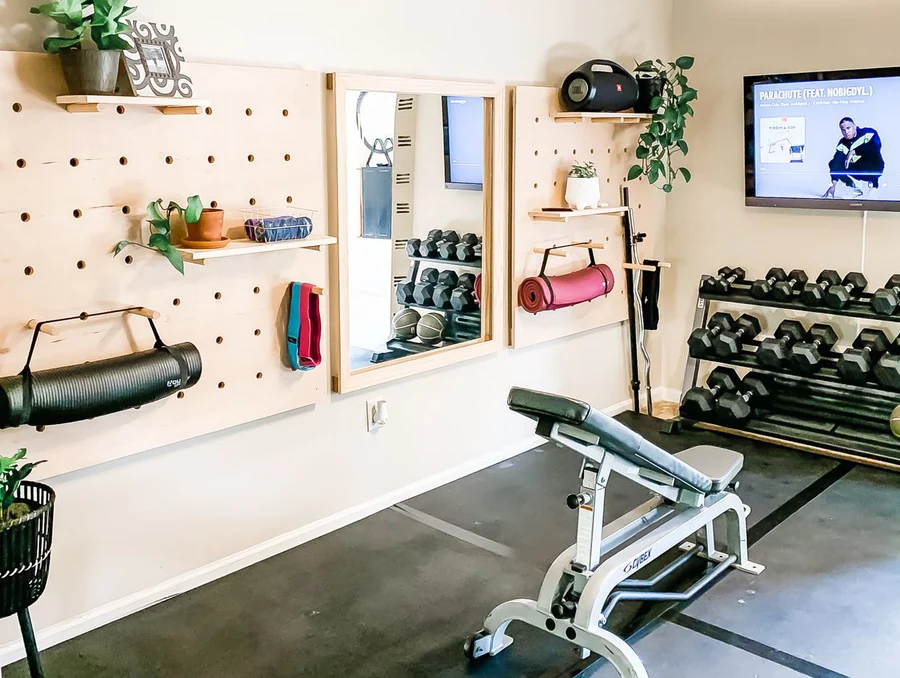
The goal of this $300 home gym setup is to get the most training variety from a small number of pieces.
Adjustable dumbbells take priority because they can be used for both upper- and lower-body exercises.
A bench expands the number of movements you can perform, while a pull-up bar and resistance bands add more options without taking much space.
Equipment
Recommended Product
Approx. Budget
Main Purpose
Adjustable Dumbbells
CAP Barbell ADJUSTABELL Adjustable Dumbbells
$100–120
Main resistance for strength training
Adjustable Bench
FLYBIRD Adjustable Weight Bench
$90–110
Pressing, rows, split squats, and supported exercises
Pull-Up Bar
Iron Gym Total Upper Body Workout Bar
$20–30
Pull-ups, chin-ups, and bodyweight training
Resistance Bands
Fit Simplify Resistance Loop Bands, 5-Pack
$10–15
Accessories, warm-ups and assistance work
Exercise Mat
BalanceFrom Puzzle Exercise Mat
$20–30
Floor protection and floor exercises
Estimated Total
$240–305
Full-body training
Prices can change, and individual product variants may have different prices. If the total goes above $300 when you are ready to buy, remove the exercise mat first if your existing floor is suitable. The next item to reconsider is the pull-up bar. The adjustable dumbbells and bench should generally make up the core of the setup.
Why This $300 Home Gym Setup Makes Sense
A $300 budget is too limited for a home gym filled with specialized machines. Instead, the money should go toward equipment that can be used for many different exercises.
This setup does that by putting most of the budget into adjustable resistance and a bench, then using inexpensive accessories to fill in the gaps.
Versatility
Adjustable dumbbells are the centerpiece because one pair can handle a wide range of exercises. You can use them for squats, Romanian deadlifts, presses, rows, lunges, curls, and shoulder exercises without needing several sets of fixed weights.
The bench makes those dumbbells even more useful. Adding an adjustable backrest gives you more pressing positions and lets you perform supported exercises that are difficult to do on the floor.
The pull-up bar and resistance bands add more options without requiring much additional money or storage space.
Exercises You Can Do
A setup like this can cover most of the basic movement patterns needed for general strength training.
Lower body:
- Goblet squats
- Romanian deadlifts
- Reverse lunges
- Bulgarian split squats
- Step-ups
Upper body:
- Dumbbell bench press
- Incline dumbbell press
- Shoulder press
- One-arm rows
- Pull-ups or chin-ups
- Biceps curls
- Triceps extensions
Core and accessory work:
- Planks
- Dead bugs
- Band pull-aparts
- Lateral band walks
- Resistance-band exercises
You won’t have the same exercise selection as a commercial gym, but you can train your legs, chest, back, shoulders, arms, and core with relatively little equipment.
Space Required
This is also a nice choice if you don’t have a dedicated gym room. The dumbbells can be stored in a small area, bands can fit in a drawer, and a doorway pull-up bar can be removed when you’re finished using it.
The bench takes up the most permanent floor space, so check its dimensions and folded size before buying. If you’re working in a bedroom, living room, or other shared space, being able to move the bench against a wall can make a big difference.
Value for Money
The main advantage of this budget home gym setup is that each major purchase serves several purposes.
Rather than spending $200 or more on a machine that trains one movement pattern, the same money can go toward equipment that supports dozens of exercises. That matters more when the entire equipment budget is only $300.
It also leaves you with a setup that can grow. You don’t have to replace everything when you have more money available. You can add heavier resistance, improve the bench, or eventually move into a rack-and-barbell setup.
Upgrade Potential
A $300 gym should be treated as a starting point rather than a finished gym.
If your strength increases and the dumbbells become too light, additional resistance should be one of the first upgrades.
If you want more exercise variety, you can then look at a better bench, a cable system, or a power rack.
That approach lets you build a home gym for $300 without spending the budget on equipment you’ll quickly outgrow or rarely use.
Adjustable Dumbbells: The Main Investment
For a home gym under $300, adjustable dumbbells should take up a large share of the budget. They give you enough loading options to train your entire body without needing a rack full of fixed dumbbells.
Recommended: CAP Barbell ADJUSTABELL Adjustable Dumbbells

The CAP Barbell ADJUSTABELL is a decent choice for this type of setup because its adjustable design saves both money and storage space compared with buying multiple pairs of fixed dumbbells.
What They Add
Dumbbells can handle most of the basic strength movements you’ll want in a starter gym:
- Goblet squats
- Romanian deadlifts
- Dumbbell bench presses
- Shoulder presses
- One-arm rows
- Reverse lunges
- Bulgarian split squats
- Biceps curls
- Triceps extensions
That makes them much more useful at this budget than equipment designed around a single exercise.
Why Adjustable Instead of Fixed Dumbbells?
A collection of fixed dumbbells can become expensive quickly and requires considerably more storage space. Adjustable dumbbells let you change the resistance as you move between exercises while keeping the equipment footprint small.
They’re particularly useful if your available space is limited. When you’re finished training, the dumbbells can stay in one small storage area rather than requiring an entire rack.
What to Check Before Buying
Pay attention to the maximum weight, adjustment system, dimensions, and whether the listing includes one dumbbell or a pair.
Also consider your current strength level. If you’re already strong enough to need heavy dumbbells for exercises such as squats or presses, a $300 budget may not provide enough adjustable weight for long-term progression. In that situation, a future upgrade to a barbell and rack may make more sense.
For most beginners and recreational lifters, however, adjustable dumbbells provide the versatility needed to make the rest of the $300 home gym setup worthwhile.
Also Check: Best Home Gym Setup Under $200 for Beginners
Adjustable Bench: The Second Priority
An adjustable bench makes the dumbbells much more versatile.
Without one, you’re limited to floor presses and standing or unsupported exercises for many movements.
With a bench, you can add flat and incline pressing, supported rows, seated exercises, and several useful lower-body variations.
Recommended: FLYBIRD Adjustable Weight Bench

The FLYBIRD adjustable bench is a suitable type of bench for this budget because it provides multiple backrest positions without requiring the footprint of a larger commercial bench.
The exact model, capacity, dimensions, and price can vary between Amazon listings, so check the current product page before buying.
What It Adds
The main benefit is exercise variety. A single adjustable bench can support:
- Flat dumbbell presses
- Incline dumbbell presses
- Seated shoulder presses
- Chest-supported rows
- Bulgarian split squats
- Step-ups
- Dumbbell pullovers
It also gives you a more stable position for several exercises, which can make your dumbbells more useful as your training progresses.
What to Check Before Buying
Don’t choose a bench based only on its advertised weight capacity. For a small home gym, also check:
- Whether it adjusts to a true flat position
- Number of backrest positions
- Overall dimensions
- Folded dimensions, if applicable
- Padding and seat design
- Stability during pressing
- Maximum user and equipment load
The bench should also fit comfortably in the space where you plan to train. Measure that area before ordering, particularly if the bench will be used in a bedroom, apartment, or shared living space.
Who Should Buy It?
A bench makes sense if you want to focus on dumbbell strength training, pressing movements, or muscle-building workouts. It is one of the better ways to expand what you can do without adding another large piece of equipment.
If you’re mainly interested in bodyweight exercises and want the smallest possible setup, you can skip the bench initially and put that portion of the budget toward heavier adjustable dumbbells or other compact equipment.
For most people building a $300 home gym setup, though, the bench is worth prioritizing after the dumbbells because it significantly increases the number of exercises you can perform with equipment you already own.
Read: Best Home Gym Setup Under $500
Pull-Up Bar for Back and Bodyweight Training
A pull-up bar is one of the cheaper ways to add vertical pulling to a home gym. That’s useful because dumbbells are excellent for rows, but they don’t provide the same movement as pull-ups or chin-ups.
Recommended: Iron Gym Total Upper Body Workout Bar

The Iron Gym Total Upper Body Workout Bar is a compact doorway-style option that can add pull-ups and chin-ups without requiring a permanent wall-mounted station.
The important point is compatibility. Door frames vary, so check the manufacturer’s requirements to make sure the bar is appropriate for your doorway before buying.
What It Adds
A pull-up bar gives you several exercises that complement the dumbbell work in this setup:
- Pull-ups
- Chin-ups
- Assisted or negative pull-ups
- Dead hangs
- Some bodyweight core variations, depending on the setup
Pull-ups and chin-ups are particularly useful here because they give you a vertical pulling movement without spending a large portion of the $300 budget on a cable machine or lat pulldown station.
What If You Can’t Do Pull-Ups Yet?
That’s not a reason to leave the bar unused. You can start with controlled negative repetitions, assisted variations, or simply use it for hangs while gradually building pulling strength.
Resistance bands can also provide assistance, giving the pull-up bar another use within the same budget.
Space Requirements
A doorway pull-up bar takes very little storage space when removed, which makes it useful for apartments and smaller rooms. However, you should check the door-frame design, available clearance, and the manufacturer’s installation and weight requirements before using one.
If your doorway isn’t suitable, skip the bar rather than trying to force it into an incompatible frame. You can use dumbbell rows and resistance-band pulling exercises until you have room in the budget for a more suitable pull-up solution.
At roughly a small fraction of the total budget, a compatible pull-up bar can add an important movement pattern without taking up permanent floor space.
Related: Best Cable Machine For Low-Ceiling Home Gym
Resistance Bands: The Low-Cost Accessory
Resistance bands aren’t the main source of resistance in this setup. Their job is to add more exercise options for relatively little money and almost no storage space.
Recommended: Fit Simplify Resistance Loop Bands, 5-Pack

The Fit Simplify five-band set is a solid option for a budget gym because the bands come in multiple resistance levels.
That makes them useful for both lighter accessory work and exercises where you need assistance.
What They Add
You can use the bands for exercises such as:
- Band pull-aparts
- Lateral walks
- Glute activation work
- Band curls
- Triceps extensions
- Assisted pull-ups
- Warm-up exercises
- Higher-repetition accessory work
They can also be useful when traveling because they take up very little room compared with weights.
Why Include Them in a $300 Gym?
The main reason is cost. You don’t need to spend another $50–100 on specialized equipment just to add more exercise variations. A small band set can cover several accessory movements while leaving most of the budget available for the adjustable dumbbells and bench.
Bands are also useful when the dumbbells aren’t the right resistance for a particular exercise. For example, they can provide lighter resistance for warm-ups or higher-repetition movements.
What to Look For
Check the resistance levels included in the set, band dimensions, material, and the manufacturer’s instructions for use. Loop bands are not interchangeable with long resistance bands that include handles, so make sure the type you buy suits the exercises you intend to perform.
Also remember that bands behave differently from free weights. Resistance generally changes throughout the movement, so they shouldn’t be treated as a direct replacement for your dumbbells.
For this home gym under $300, they’re best viewed as a cheap way to fill gaps in your training rather than the centerpiece of the setup.
Also See: Best Home Gym Setup Under $1000
Do You Need Home Gym Flooring?
Flooring is useful, but it shouldn’t take priority over your main training equipment when you’re working with only $300. If your existing floor is already suitable for exercise and you can train without damaging it, this is one area where you can save money.
Recommended: BalanceFrom Puzzle Exercise Mat
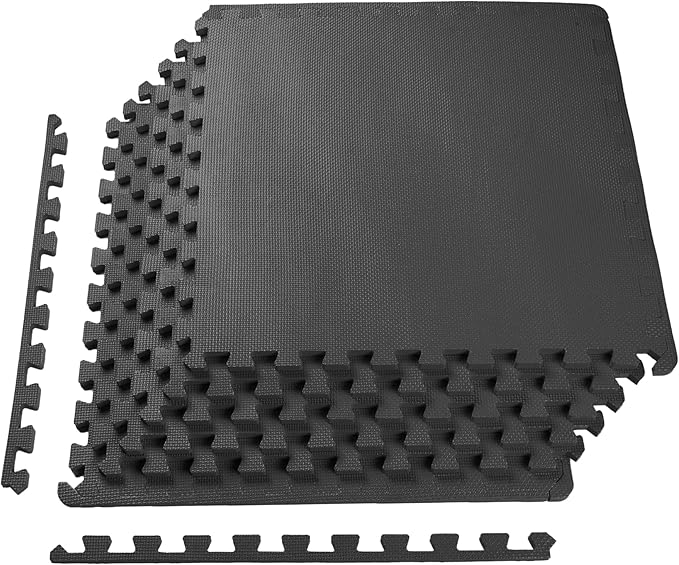
Interlocking EVA foam tiles such as the BalanceFrom Puzzle Exercise Mat can provide a more comfortable surface for floor exercises and give some protection from equipment contacting the floor.
What It Adds
A basic exercise mat or tile system can help with:
- Floor-based core exercises
- Stretching and mobility work
- Kneeling exercises
- General workout comfort
- Protecting suitable floors from normal exercise use
It can also help define a small training area if you’re exercising in a bedroom, living room, or other shared space.
Don’t Overspend on Flooring!
For a budget home gym setup, expensive rubber flooring isn’t necessary just because you’re creating a workout area. If you’re using relatively light adjustable dumbbells and aren’t dropping weights, a simple exercise mat may be enough.
If you already have carpet, a suitable hard floor, or another surface that works for your training, put the flooring money toward equipment instead.
If your final cart is over $300, flooring is therefore one of the first items I’d remove. The adjustable dumbbells and bench provide far more training value for this particular budget.
What Not to Buy for a $300 Home Gym
With only $300 to spend, the biggest mistake is buying equipment that uses a large part of the budget while giving you only a narrow range of exercises. A $300 home gym setup works better when each purchase can serve several purposes.
- Skip a Full Cable Machine
Cable machines can be useful, but they generally don’t make sense as a first purchase at this budget. A reasonably equipped cable station can consume most of the money before you’ve bought weights, a bench, or anything else.
Resistance bands can cover some cable-style movements until you have more money to spend.
- Skip a Power Rack and Barbell Setup
A rack, Olympic barbell, plates, and bench can make an excellent long-term gym, but buying all of them for $300 usually means making significant compromises on the amount of weight and quality of the equipment.
It’s better to start with adjustable dumbbells and add a rack-and-barbell setup later when the budget allows.
- Skip Large Cardio Machines
Treadmills, ellipticals, and exercise bikes can take up a substantial amount of both money and floor space.
If cardio is a priority, you can use walking, running, cycling outdoors, or bodyweight conditioning while you build the strength side of your gym. You don’t need to spend most of your initial budget on a single cardio machine.
- Skip Specialized Machines
At this price point, avoid equipment designed around one specific exercise or muscle group, such as:
- Leg extension machines
- Preacher curl machines
- Pec decks
- Dedicated ab machines
- Calf machines
Your dumbbells and bench can provide several exercises for the same muscle groups without dedicating valuable space and budget to one movement.
- Skip Unnecessary Accessories
It’s easy to turn a small equipment budget into a collection of things that don’t actually improve your workouts. You probably don’t need a weight tree, gym mirror, specialty handles, expensive storage, or other accessories when you’re just getting started.
Spend the first $300 on resistance, stability, and exercise variety. Add convenience items after the core equipment is in place.
Alternative: Small-Space $300 Home Gym Setup
If you don’t have room for a bench or want equipment that can be put away after every workout, you can shift the budget toward a more compact setup.
A simple small-space allocation:
- Adjustable dumbbells
- Resistance loop bands
- Doorway pull-up bar, if your door frame is compatible
- Foldable exercise mat
- The remaining budget toward heavier dumbbells or a compact adjustable bench
The main difference is that you give up some of the supported exercises that a bench provides. In return, almost everything can be stored in a closet, under a bed, or against a wall when you’re finished.
This makes more sense for an apartment or shared room where floor space matters as much as the equipment budget. If you already have a sturdy bench or another suitable surface, keep it and put the money toward additional resistance instead.
What to Buy Next After Your First $300
A $300 home gym doesn’t need to be finished all at once.
Once you’ve used the equipment for a while, you’ll have a better idea of what is actually limiting your workouts.
That makes it easier to spend your next $100, $200, or $500 on something useful rather than simply adding more equipment.
If You Have Another $100
Put the money toward more resistance if your current dumbbells are becoming too light.
Depending on the equipment you bought initially, this could mean upgrading to a heavier adjustable dumbbell system or adding compatible weight. If your current resistance is still sufficient, a better pull-up setup or a more durable bench may make more sense.
If You Have Another $200
At this point, you can start improving exercise variety.
A heavier adjustable dumbbell system is still a sensible option if you’re limited by weight.
Otherwise, consider upgrading the bench or adding a compact cable-style system that gives you more pulling and isolation exercises.
The right choice depends on what you actually find yourself missing during workouts.
If You Have Another $500
This is where a rack-and-barbell setup becomes more realistic.
A power rack, Olympic barbell, weight plates, and a suitable bench can give you access to heavier compound lifts such as squats, bench presses, and deadlifts.
You’ll need considerably more floor space, though, so this upgrade makes more sense in a garage, basement, or dedicated gym room.
You don’t need to replace your original equipment when you make this jump. The dumbbells, bands, and pull-up bar can continue to handle accessory and lighter work!
FAQs: Building a Home Gym for $300
Can you really build a home gym for $300?
Yes. A $300 budget can cover a compact strength-focused gym with adjustable dumbbells, a bench, and a few inexpensive accessories. It won’t provide the range of equipment found in a commercial gym, but it can cover most basic full-body strength movements.
What is the most important equipment for a $300 home gym?
Adjustable dumbbells should generally be the first priority because they can be used for both upper- and lower-body exercises. A bench is the next major addition if you want to perform pressing and supported exercises.
Is a bench worth buying on a $300 budget?
For most strength-focused setups, yes. A bench significantly expands what you can do with the dumbbells you already own. However, if you’re short on space or primarily perform bodyweight exercises, you can skip it initially and put the money toward resistance or compact equipment.
Can I build a $300 home gym without a pull-up bar?
Yes. You can train your back with dumbbell rows and use resistance bands for additional pulling exercises. A pull-up bar is useful because it adds vertical pulling, but it isn’t essential if your doorway isn’t suitable for one.
What should I buy first if I can only spend $150?
Prioritize adjustable dumbbells. They give you the widest range of strength exercises from a single purchase. Once you have enough resistance to train effectively, save for a bench rather than filling the remaining budget with small accessories.
Can a $300 home gym replace a commercial gym?
It can cover a substantial amount of general strength training, but it won’t reproduce the equipment selection, maximum loading, cardio machines, or specialized machines of a commercial gym.
The goal of a $300 setup is to cover the basics efficiently and provide a foundation you can expand later.
Bottom Line
You don’t need to spend a fortune to get started with a home gym.
With $300, I’d keep things simple: put most of the money into adjustable dumbbells, add a decent bench if you have the space, and use bands and a pull-up bar to cover the gaps. That’s enough to train your whole body without filling your room with equipment.
I wouldn’t worry about buying machines or fancy accessories yet. Start with the basics and see what you actually feel you’re missing. Then you can put your next $100 or $200 toward an upgrade that will genuinely make your workouts better!