Planning to add a power rack to your home gym? Use the calculator below to check whether your rack fits your ceiling and available floor space. It also checks pull-up headroom, barbell side clearance, rack footprint, and basic exercise compatibility.
Enter your room and rack measurements for a quick fit report before you buy or install your equipment. Planning your entire setup instead? Use our Home Gym Space Calculator to check what equipment can fit in your available room.
Check Your Power Rack Fit
Your Room
Enter the usable dimensions where your power rack will sit.
Your Power Rack
Use the manufacturer's assembled dimensions whenever possible.
Your Setup
Add your barbell and body measurements for a more useful fit check.
What Do You Want to Do?
Select the exercises you plan to perform with your rack.
Planning estimate only. Always verify the rack manufacturer's dimensions, installation instructions and required safety clearances before buying or installing equipment.
Power Rack Fit Report
What This Means
How Much Ceiling Height Do You Need for a Power Rack?
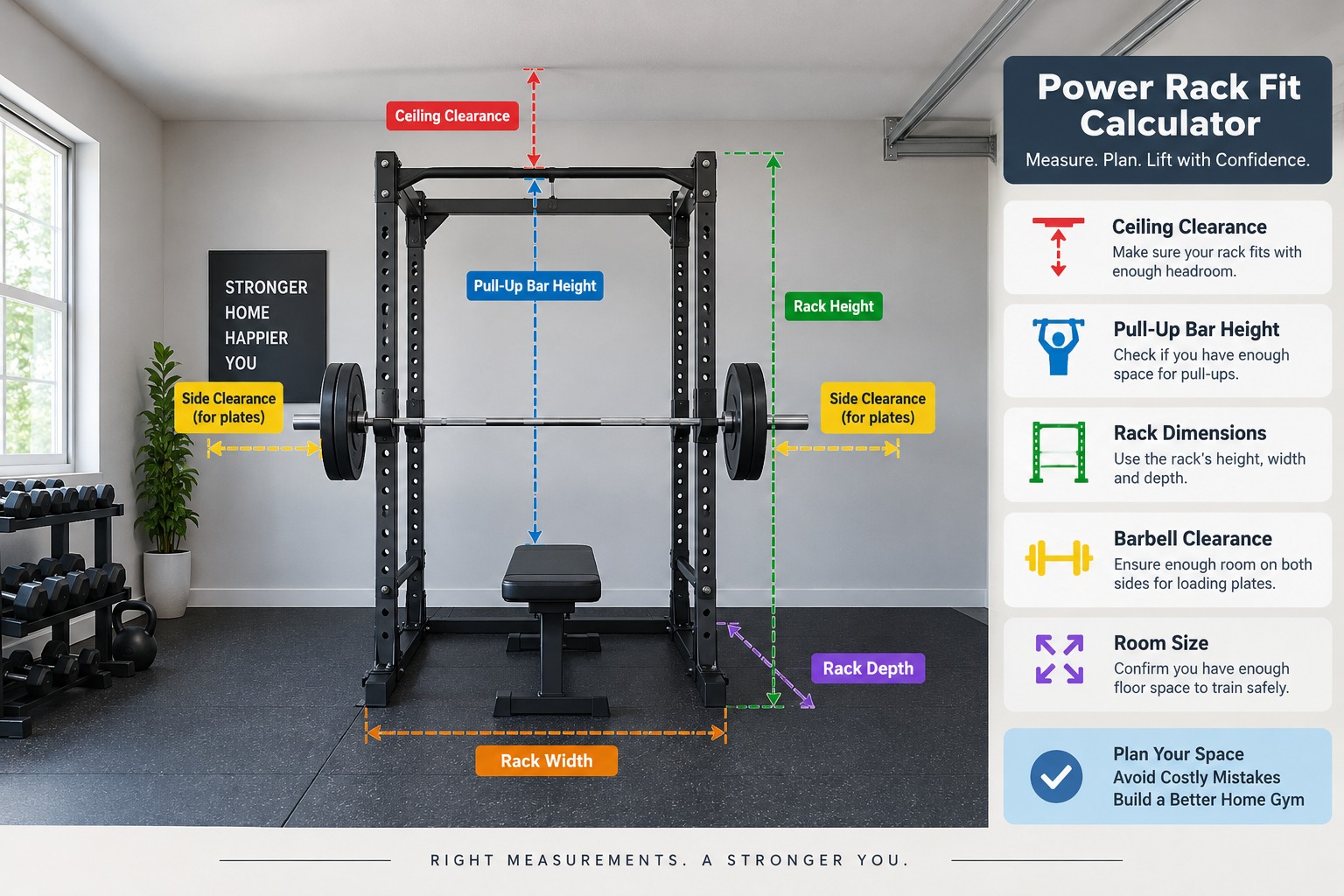
The ceiling height you need depends on the height of the power rack, your flooring, the position of the pull-up bar, and how you plan to use the rack.
Don’t compare the advertised rack height with the room’s ceiling height alone. Thick rubber flooring reduces the usable height, and beams, lights, ducts, garage door tracks, or other obstructions may make the actual clearance lower.
For example, if your lowest ceiling clearance is 96 inches and your gym flooring is 0.5 inches thick, you have about 95.5 inches of usable vertical space.
Your rack should fit below that height with enough additional clearance for installation and your intended exercises.
Power Rack Ceiling Clearance for Pull-Ups
A power rack can physically fit under your ceiling while still being too tall for comfortable pull-ups.
The important measurement is the distance between the pull-up bar and the lowest obstruction above it.
For example:
- Usable ceiling height: 96 inches
- Pull-up bar height: 84 inches
- Space above pull-up bar: 12 inches
More headroom generally gives you more freedom at the top of the movement. If clearance is limited, you may need to bend your knees, avoid bringing your head too far above the bar, or choose a shorter rack.
This is particularly important when choosing a power rack for a low-ceiling basement or garage gym.
How Much Floor Space Does a Power Rack Need?
Rack dimensions only tell you how much space the frame occupies. You also need room to load your barbell, position your bench, move around the rack, and use attachments safely.
A rack measuring 48 inches wide by 48 inches deep has a basic footprint of about 16 square feet, but your usable setup will require more room than that.
Check both your room width and depth before purchasing a rack, especially in a small home gym.
Don’t Forget Barbell Clearance
This is easy to overlook.
A standard Olympic barbell is approximately 7 feet long. Even if your power rack fits comfortably, a narrow room can leave very little space beside the bar for loading and unloading weight plates.
For example, an 84-inch bar inside a 10-foot-wide room leaves:
120 − 84 = 36 inches
That gives approximately 18 inches of clearance on each side if the bar is centered.
Our power rack space calculator checks this automatically.
Will a Power Rack Fit Under an 8-Foot Ceiling?
Many power racks can fit under an 8-foot ceiling, but you should check the exact rack height rather than relying on the product category.
An 8-foot ceiling provides 96 inches of total height before accounting for flooring or other obstructions.
An 84-inch rack, for example, would leave roughly 12 inches before flooring is considered. A significantly taller rack could leave much less usable clearance.
Also check the rack’s assembly instructions. A rack that fits once assembled may require additional space during installation.
Power Racks for Low Ceilings
If you’re building a home gym in a basement, garage, or another room with a low ceiling, look beyond overall rack height.
Consider:
- Rack height
- Pull-up bar position
- Flooring thickness
- Lowest ceiling obstruction
- Installation clearance
- Your own height and training needs
- Barbell and plate-loading space
A shorter rack or squat stand can sometimes make more sense than forcing a full-height rack into a tight room.
Frequently Asked Questions
How tall is a typical power rack?
Power rack heights vary considerably by model. Always use the manufacturer’s exact assembled dimensions rather than assuming a standard height.
How much clearance should be above a power rack?
There isn’t one clearance that works for every rack. Installation method, pull-up use, attachments, flooring, and manufacturer requirements can all change how much space you need.
Can I put a power rack in a basement?
Yes, if the rack fits the available ceiling height and floor space. Measure to the lowest obstruction, not simply the nominal basement ceiling.
Does gym flooring affect rack height clearance?
Yes. Flooring raises the rack closer to the ceiling. Enter the thickness of your rubber mats or lifting platform when calculating usable ceiling height.
How wide should a room be for a 7-foot barbell?
The room must be wider than the 7-foot bar itself, but additional space on both ends makes loading plates much easier. Use the calculator above to see your available side clearance.