Basement ceilings can make buying an elliptical a little frustrating.
A machine may look short enough on the specs sheet, but once you’re standing on the pedals, your head is several inches higher. Add a low beam or ductwork, and things get even tighter.
That’s why finding the best elliptical for low ceiling basement use isn’t just about finding the shortest machine. You need to look at your height, the machine’s step-up height, and the actual ceiling clearance.
I’ve narrowed it down to five options worth considering, including an elliptical for 7 foot ceiling spaces.
Quick Comparison: Best Ellipticals for a Low-Ceiling Basement
Before getting into the details, here’s a quick look at the five ellipticals. I’ve focused on the measurements that actually matter in a basement, especially machine height, stride length, and weight capacity.
Product
Best For
Height
Stride
Weight Capacity
Key Feature
Sunny Health & Fitness SF-E3912
Best Overall
64.5″
15.5″
330 lb
Low overall height
Niceday CT11S
High-Capacity Option
~62″
15.5″
400 lb
Very low profile
Niceday CT11-19
Longer Stride
~62″
19″
400 lb
Long stride at a low height
Schwinn 411
Compact Option
Check current listing
18″
Check current listing
Compact design
Horizon EX-59
Traditional Elliptical
64.5″
18″
300 lb
Low step-up height
One thing to keep in mind: machine height isn’t the same as the amount of headroom you’ll have while exercising. Your own height and the pedal position matter just as much.
1. Sunny Health & Fitness SF-E3912 – Best Overall

The SF-E3912 is a good fit if you want a straightforward elliptical that stays relatively low without taking up an excessive amount of space.
- Height: 64.5 inches
- Stride length: 15.5 inches
- Weight capacity: 330 lb
- Resistance levels: 16
- Footprint: approximately 55″ L × 23″ W
The 64.5-inch height gives the SF-E3912 a useful advantage in a basement where every inch counts. It isn’t the shortest machine here, but it’s still considerably easier to work with than many full-size ellipticals.
The 15.5-inch stride also keeps the overall design fairly compact. For a shorter or average-height user, that can be a nice balance between having enough room to move and keeping the machine manageable in a basement.
Just remember to measure your actual head clearance. If you’re tall and working with a 7-foot ceiling, you shouldn’t assume the 64.5-inch machine height leaves 19.5 inches of usable space above your head.
What We Like
- Relatively low 64.5-inch height
- 330-lb weight capacity
- 16 resistance levels
- Compact enough for many home gyms
What Could Be Better
- The 15.5-inch stride may feel short for taller users.
- It doesn’t have the lowest height in this group.
The SF-E3912 is a sensible all-around pick if you need an elliptical for low ceilings but still want a conventional machine with decent resistance options. I’d look at the Niceday CT11-19 instead if you’re tall and want a longer stride.
Related: Best Dip Stations for Small Spaces (Compact Home Gym Picks)
2. Niceday CT11S – Best High-Capacity Option

The CT11S makes sense if you want a low-profile elliptical with a higher weight capacity and don’t need a particularly long stride.
- Height: approximately 62 inches
- Stride length: 15.5 inches
- Weight capacity: 400 lb
- Footprint: approximately 48″ L × 25″ W
- Resistance: 16 levels
At around 62 inches tall, the CT11S gives you a little more vertical room than most of the other machines on this list. Those extra couple of inches can matter when you’re dealing with a basement ceiling that’s right around 7 feet.
The 15.5-inch stride also keeps the machine relatively compact. That makes it easier to work into a basement gym where both ceiling and floor space are limited.
Still, don’t treat the 62-inch measurement as your required ceiling height. Once you’re standing on the pedals, your head will be considerably higher than the top of the machine. Measure the machine’s placement, your height, and the lowest point of the ceiling before buying.
What We Like
- Very low overall height
- 400-lb weight capacity
- Compact footprint
- Good choice when vertical clearance is the main concern
What Could Be Better
- 15.5-inch stride may feel restrictive for some taller users.
- Less suitable if you specifically want a long-stride elliptical.
The CT11S is worth considering if ceiling clearance is your biggest concern and you want a higher-capacity machine. It’s particularly interesting for basement gyms where a few extra inches of vertical room can make a real difference.
3. Niceday CT11-19 – Best Long-Stride Option

The CT11-19 is a good choice for taller users who want more room in their stride without moving to a much taller elliptical.
- Height: approximately 62 inches
- Stride length: 19 inches
- Weight capacity: 400 lb
- Footprint: approximately 48″ L × 24.4″ W
- Product weight: approximately 104 lb
This is probably the most interesting option on the list if you’re tall. You get a 19-inch stride while the machine itself is only around 62 inches high. That’s a useful combination when you’re trying to fit an elliptical into a basement with limited vertical space.
The longer stride should also feel less cramped than the 15.5-inch models, particularly for taller users. But there’s a catch: a longer stride doesn’t necessarily mean less vertical movement. Your own height and how high your feet rise still matter.
So if you’re looking for a compact elliptical for basement use, this one gives you a nice balance of a relatively small frame and a more generous stride.
What We Like
- 19-inch stride
- Approximately 62-inch height
- 400-lb weight capacity
- Good fit for taller users
What Could Be Better
- Still requires careful headroom measurement.
- May take up more practical space than the height alone suggests.
The CT11-19 stands out if you don’t want a short stride just because you have a low ceiling. I’d consider it first if you’re taller and need an elliptical for low ceilings that still gives you a more natural stride.
See: Best Cable Machine For Low-Ceiling Home Gym
4. Schwinn 411 – Best Compact Option

The Schwinn 411 is a good fit if you’re working with limited floor space and want a compact elliptical for a basement gym.
- Stride length: 18 inches
- Footprint: compact design
- Resistance: multiple resistance levels
- Weight capacity: check the current model listing for the exact specification
The 411 is much more compact than many full-size ellipticals, which makes it easier to fit into a basement where floor space is already limited. Its 18-inch stride is also useful if you don’t want to drop down to a very short stride just to save space.
The bigger question is vertical clearance. With a low ceiling, you can’t judge this one by footprint alone. Measure the machine’s actual height, then factor in your height while standing on the pedals. That matters even more if you’re trying to fit an elliptical for 7 foot ceiling use.
What We Like
- Compact overall design
- 18-inch stride
- Easier to fit into a smaller home gym
- Simple setup compared with larger machines
What Could Be Better
- Less feature-rich than larger ellipticals.
- Exact clearance should be checked carefully before buying.
The Schwinn 411 makes the most sense when floor space is nearly as tight as ceiling space. Just make sure its current listed height works with your own height before putting it in a low basement.
5. Horizon EX-59 – Best Traditional Elliptical
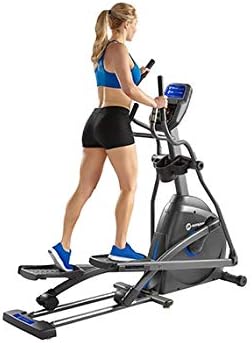
The Horizon EX-59 is a good option if you want a more traditional elliptical feel without going to a particularly tall machine.
- Height: 64.5 inches
- Stride length: 18 inches
- Weight capacity: 300 lb
- Step-up height: approximately 10.75 inches
- Footprint: approximately 69″ L × 25″ W
The EX-59 has a useful combination of a relatively low frame and an 18-inch stride. That’s important if you want a fuller stride but don’t have room for a much taller machine.
I also like that the step-up height is relatively low. With a low basement ceiling, every inch between your feet and the ceiling matters. A lower starting position can help, although you still need to calculate your actual headroom while exercising.
At 64.5 inches tall, this isn’t the shortest low step up elliptical on the list. But if you have a little more room and want a conventional elliptical rather than an ultra-compact model, it makes sense.
What We Like
- 18-inch stride
- Relatively low 64.5-inch height
- Low step-up height
- 300-lb weight capacity
What Could Be Better
- Larger footprint than the compact options.
- Not suitable for every very-low basement ceiling.
- Lower weight capacity than the Niceday models.
The EX-59 is worth considering if you have enough vertical clearance and want a more traditional elliptical experience. For very tight basement ceilings, I’d compare its dimensions carefully against the shorter Niceday models before buying.
Also See: Best Glute Machine for Home Gym
How to Choose the Right Elliptical for a Low-Ceiling Basement
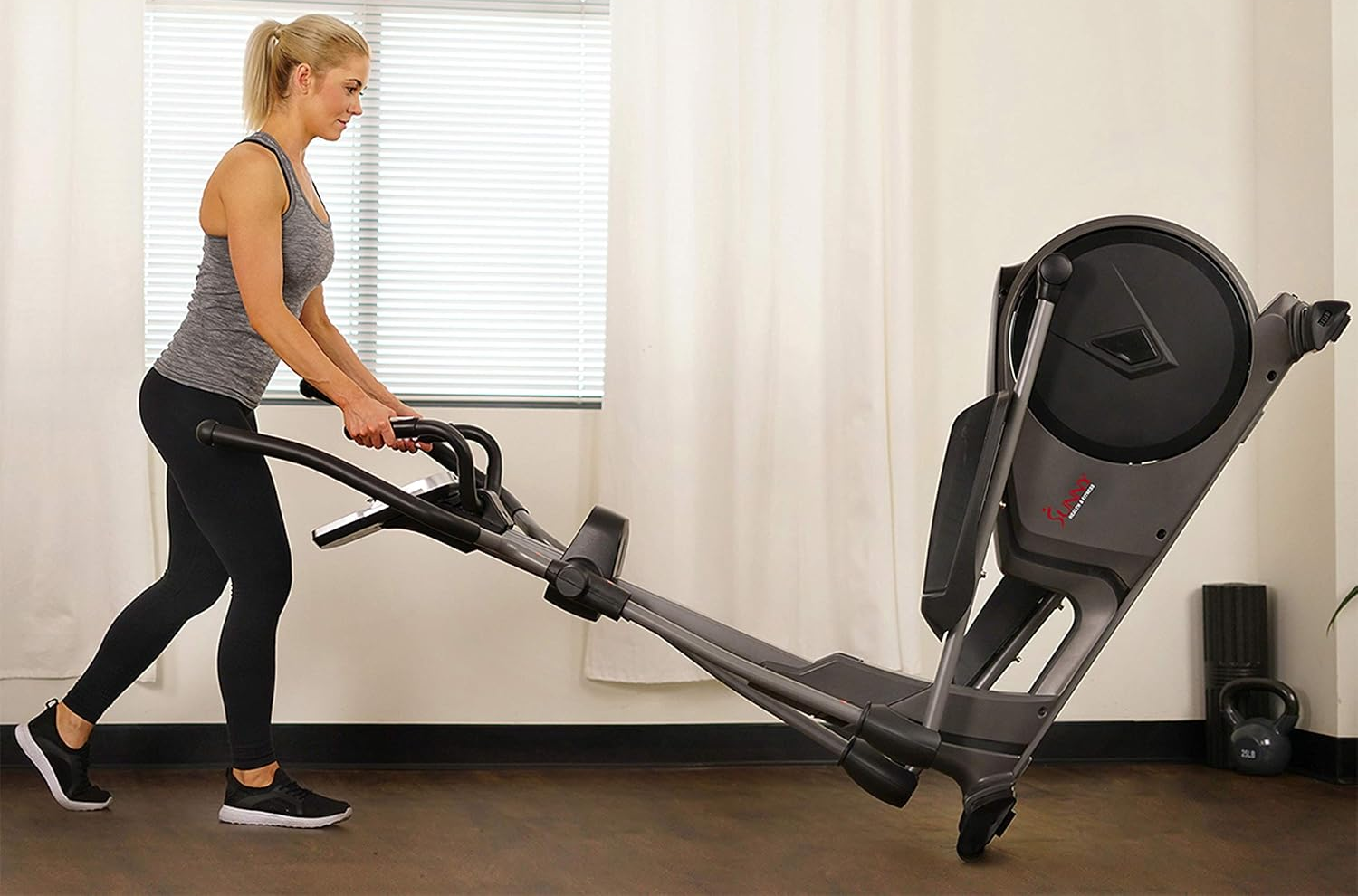
Buying an elliptical for a basement is mostly a clearance problem. The machine needs to fit, but more importantly, you need to fit comfortably on it while moving.
Measure the Ceiling at the Exact Location
Don’t measure the highest point of the basement and call it good. Check the exact spot where you plan to put the elliptical. Look for:
- Exposed beams
- Ductwork
- Pipes
- Light fixtures
- Soffits
- Uneven flooring
A basement listed as having a 7-foot ceiling may have considerably less usable height in certain areas.
Don’t Look at Machine Height Alone
This is probably the biggest mistake people make. If an elliptical is 62 inches tall, that doesn’t mean you have 22 inches of headroom under a 7-foot ceiling.
Your feet are elevated on the pedals, and your body moves as you exercise. Your own height matters too. Before buying, think about:
Ceiling height − your standing height − pedal elevation/movement = usable headroom
I would leave some extra room rather than choosing a machine that technically fits with only an inch or two to spare.
Consider Your Height
A machine that works comfortably for a 5’6″ user may not work nearly as well for someone who’s 6’2″. Taller users should pay particular attention to:
- Pedal height
- Stride length
- Highest point of the elliptical motion
- Distance between their head and the ceiling
This is especially important when shopping for an elliptical for low ceilings.
Look at Step-Up Height
Step-up height tells you how high your feet are positioned when you get onto the machine. A lower step-up can help when ceiling clearance is tight because you’re starting closer to the floor.
Still, don’t use step-up height as a substitute for measuring actual headroom. It’s just one part of the calculation.
Think About Stride Length
Stride length is another tradeoff.
A 15.5-inch stride can help keep a machine compact, while an 18- or 19-inch stride may feel more natural for taller users. But a longer stride doesn’t automatically make a machine better for a basement.
The goal is to find the longest stride that works without creating a ceiling-clearance problem.
Don’t Forget Floor Space
Ceiling height gets most of the attention, but basement space can be tight in both directions. Leave enough room to:
- Step onto and off the elliptical
- Move around the machine
- Open nearby doors
- Avoid walls and other equipment
- Place a protective mat underneath
If you’re building a smaller home gym, a compact elliptical for basement use can make the rest of the layout much easier to manage.
5 Mistakes to Avoid When Buying an Elliptical for a Low-Ceiling Basement
A few small measurement mistakes can turn an otherwise good elliptical into a frustrating basement purchase.
- Only Checking the Machine Height
A 62-inch elliptical doesn’t automatically mean it will work under a 7-foot ceiling. Your body sits higher than the top of the frame once you’re on the pedals.
- Forgetting Your Own Height
Don’t use someone else’s measurements as a reference. Taller users need more overhead clearance, and the difference can be significant in a basement.
- Measuring the Highest Part of the Ceiling
Always measure the lowest point directly above where the elliptical will sit. A beam, pipe, or duct can easily take away several inches.
- Ignoring Pedal Movement
Your feet don’t stay at one fixed height during an elliptical workout. The pedals move, so you need to account for the highest position you’ll reach during the stride.
- Leaving Almost No Extra Clearance
If your calculations show that your head will be just an inch or two below the ceiling, I’d reconsider the setup. You want enough room to exercise naturally without constantly worrying about hitting your head.
FAQs About Ellipticals for Low-Ceiling Basements
Can you use an elliptical with a 7-foot ceiling?
Yes, but it depends on your height and the elliptical’s pedal elevation. A shorter machine doesn’t automatically guarantee enough headroom. For an elliptical for 7 foot ceiling setups, measure your standing height on the pedals and compare it with the lowest point of the ceiling.
How much ceiling clearance do I need for an elliptical?
There isn’t one number that works for everyone. Your height, the machine’s height, pedal position, and stride mechanics all affect the clearance you need. Measure the actual setup rather than relying only on the manufacturer’s machine height.
What should I look for in an elliptical for low ceilings?
Start with machine height, then check step-up height, stride length, and your own height. A lower frame and lower pedal position can make a machine easier to fit, but you still need to calculate your actual headroom.
Is a low step-up elliptical better for a low ceiling?
It can help. A lower step-up means you’re starting closer to the floor, which can give you more usable headroom. However, it doesn’t tell you how high your head will reach during the full exercise motion.
Are compact ellipticals good for basements?
They can be. A compact elliptical can save valuable floor space, which is helpful when you’re also trying to work around walls, support posts, storage areas, or other gym equipment. Just make sure the machine is also low enough for your ceiling.
Is a 15.5-inch stride enough for a tall person?
It may feel short for some taller users. If you’re tall, an 18- or 19-inch stride may feel more natural. The tradeoff is that you still need to make sure the machine’s movement doesn’t create a ceiling-clearance issue.
To Conclude
If I were setting up an elliptical in my basement, I’d start with the Sunny SF-E3912. It strikes me as the easiest all-around choice without taking up too much vertical space.
If my ceiling were really tight, I’d lean toward the Niceday CT11S for its lower profile.
And if I were taller, I’d seriously consider the Niceday CT11-19 because that 19-inch stride gives you more room to move.
The one thing I wouldn’t skip is measuring my actual headroom. I’d check the lowest part of the ceiling, account for how high I sit on the pedals, and leave a little extra space.
See, it’s much better to spend five minutes with a tape measure than discover after delivery that your new elliptical is a little too tall!