Building a home gym on a $200 budget means you have to spend your money carefully.
You won’t get a full commercial-style gym on this budget, but you can still build a practical setup for full-body strength training.
The key is choosing versatile equipment that can handle lots of exercises without taking up much space.
This home gym setup under $200 focuses on adjustable dumbbells, a basic bench, resistance bands, and bodyweight exercises, giving you a starting point without filling your room with unnecessary equipment.
Complete Home Gym Setup Under $200
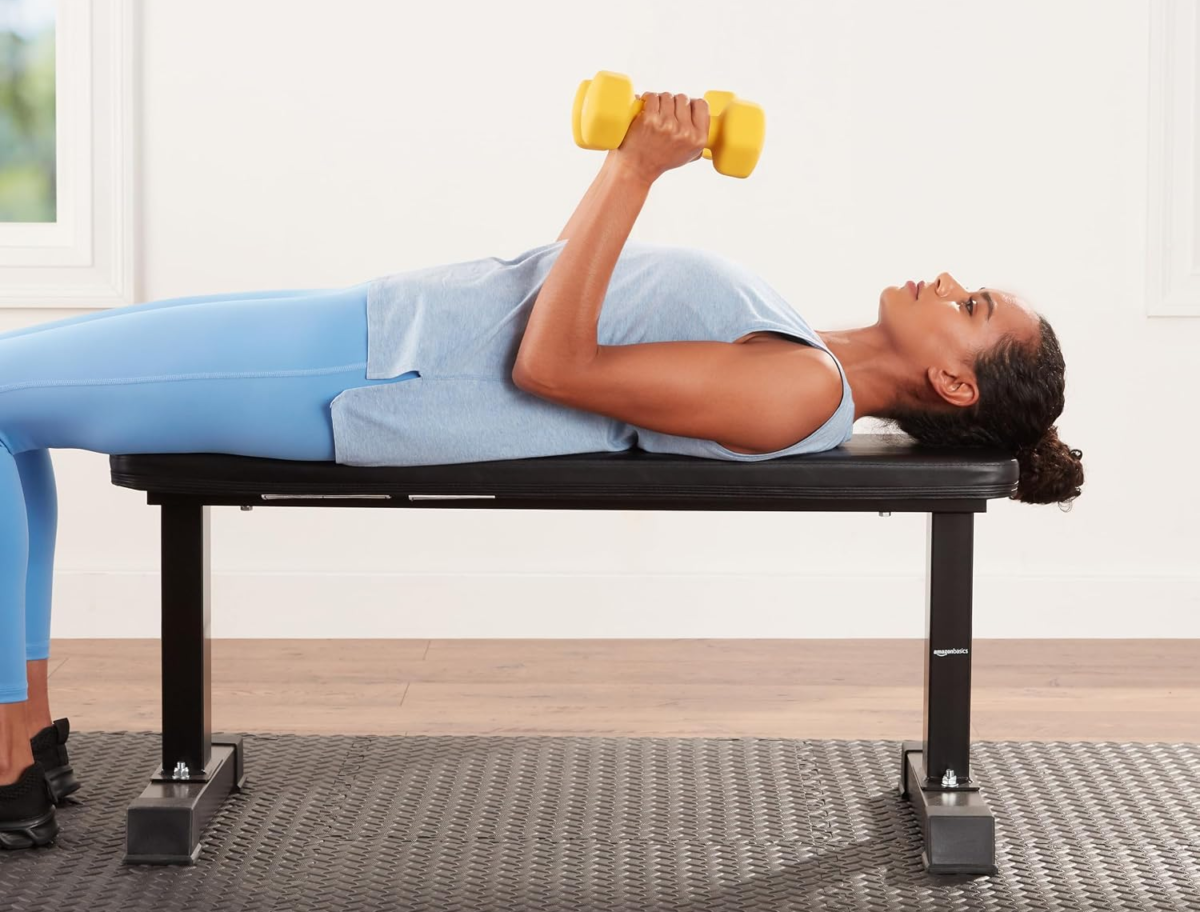
As you will see below, you don’t need a lot of equipment to get started. The goal is to spend most of the budget on equipment you’ll use for many different exercises, while keeping the smaller purchases inexpensive. Here is the setup I’d aim for:
Equipment
Recommended Product
Target Budget
Purpose
Adjustable dumbbells
Amazon Basics Adjustable Dumbbells
$70–90
Main strength training
Flat bench
Amazon Basics Flat Weight Workout Exercise Bench
$40–50
Presses, rows, split squats
Resistance bands
Fit Simplify Resistance Loop Exercise Bands, Set of 5
~$10
Assistance and accessory exercises
Doorway pull-up bar
Suitable Perfect Fitness or comparable pull-up bar
$25–35
Pull-ups and chin-ups
Exercise mat
Amazon Basics exercise mat
$15–20
Floor exercises and comfort
Target total
About $160–205
Prices on Amazon can change, so treat these figures as a guide rather than a fixed checkout total. If the complete setup goes over $200, skip the exercise mat first. If you still need to reduce the cost, postpone the pull-up bar and put that money toward the adjustable dumbbells.
The dumbbells should get the largest share of your budget because they will be the most versatile piece of equipment. The bench, bands, and pull-up bar then add more exercises without requiring much additional space.
What Can You Train With This $200 Home Gym?
| Muscle Group | Exercises |
|---|---|
| Chest | Dumbbell bench press, floor press, push-ups |
| Back | Dumbbell rows, pull-ups, band rows |
| Shoulders | Shoulder press, lateral raises, band work |
| Legs | Goblet squats, lunges, Romanian deadlifts, split squats |
| Arms | Curls, triceps extensions, chin-ups |
| Core | Planks, hanging knee raises, weighted core exercises |
This is primarily a compact, strength-focused beginner setup rather than a full commercial gym. With a few versatile pieces, you can train most major muscle groups without needing a lot of equipment or space.
Why This Setup Makes Sense
With a $200 budget, every piece of equipment needs to earn its place. Instead of buying several cheap items that only do one or two exercises, this setup focuses on equipment you can use in many different ways.
Versatility
Adjustable dumbbells are the main part of the setup because they can be used for both upper- and lower-body training. You can do squats, lunges, Romanian deadlifts, rows, presses, shoulder work, curls, and more with the same pair.
The bench adds even more options. It gives you a stable surface for dumbbell presses, seated exercises, chest-supported rows, and exercises such as Bulgarian split squats.
Resistance bands and a pull-up bar fill in some of the movements that dumbbells don’t handle as well, particularly assisted pull-ups, chin-ups, band rows, and face pulls.
Value for Money
The main idea is to spend most of the $200 on equipment that you’ll continue using as your gym grows. A cheap accessory that sits unused isn’t a good bargain.
That’s why the adjustable dumbbells come first. If you have to make cuts because prices have gone up, skip optional items such as the exercise mat before sacrificing the main source of resistance.
Room to Upgrade
This doesn’t have to be your final home gym. As your budget increases, you can replace the basic equipment with heavier dumbbells, a better bench, a squat rack, a barbell, or a cable system.
Starting with a small setup also lets you figure out what type of training you actually enjoy before spending hundreds of dollars on larger equipment.
How Much Space Do You Need for a $200 Home Gym?
One thing that’s easy to overlook is the difference between storage space and workout space.
The equipment in this setup doesn’t take up much room when it’s stored. You can keep the dumbbells under or beside the bench, fold away the bands, and move the bench against a wall when you’re done.
But you still need enough clear floor space to actually use everything safely. Lunges, split squats, dumbbell rows, presses, and other exercises require room to move without hitting furniture, walls, or other equipment.
A small corner of a bedroom, garage, or living room can work, as long as you can create a clear training area around the equipment.
Not sure if everything will fit? Use our Home Gym Space Calculator to plan your available workout area before buying equipment.
Adjustable Dumbbells
If you’re building a home gym with $200, adjustable dumbbells should get the biggest share of your budget. They give you enough resistance for a wide range of exercises without taking up the space or money required for a full set of fixed dumbbells.
Recommended Product: Amazon Basics Adjustable Dumbbells

The Amazon Basics Adjustable Dumbbells are a good fit for this type of budget build because you’re getting adjustable resistance in a relatively compact package. Instead of buying several pairs of dumbbells, you can change the weight depending on the exercise.
For this setup, look for the version with the highest useful weight range you can fit into the budget. The exact price and available configuration can change, so check the current Amazon listing before buying.
What You Can Do With Them
These dumbbells can cover most of the basic movements you’ll need for a full-body workout, including:
- Goblet squats
- Romanian deadlifts
- Reverse lunges
- Bulgarian split squats
- Dumbbell rows
- Floor presses
- Bench presses
- Shoulder presses
- Biceps curls
- Lateral raises
- Triceps extensions
That makes them much more useful than spending the same money on a single-purpose machine.
How Much Space Do They Need?
Very little. You only need enough room to pick up the dumbbells safely and perform your exercises without hitting furniture or walls.
When you’re finished, they can be stored under a bench, beside a wall, or in another small storage area. This makes them particularly useful if your home gym is also a bedroom, living room, or garage corner.
Who Should Buy Them?
Adjustable dumbbells make the most sense if you’re starting from scratch and want one piece of equipment that can handle most of your strength training.
They’re also a good choice if you don’t have room for a barbell and weight plates. If your budget is extremely tight, prioritize the dumbbells over optional equipment such as an exercise mat or extra accessories.
Next is the bench section. I’d keep it practical and avoid overselling a bench at this budget—the dumbbells remain the priority.
Flat Weight Bench
A basic flat bench is one of the simplest ways to get more use out of your dumbbells. You don’t need an expensive adjustable bench for a $200 home gym. A stable flat bench is enough for many of the exercises you’ll want to do.
Recommended Product: Amazon Basics Workout Exercise Bench

The Amazon Basics Flat Weight Workout Exercise Bench is the type of bench that makes sense for this budget. It provides a stable surface for pressing and supported exercises without taking up much room.
What You Can Do With It
Adding a bench gives you more options for your dumbbells, including:
- Dumbbell bench press
- Chest-supported dumbbell rows
- Seated shoulder press
- Bulgarian split squats
- Hip thrusts
- Seated curls
- Dumbbell flyes
You can still train without a bench, but having one makes the setup more versatile.
How Much Space Do You Need?
A flat bench has a fairly small footprint and can usually be pushed against a wall when you’re not using it. You should still leave enough clear space around it to safely perform exercises with dumbbells.
If you’re working in a small bedroom or apartment, measure the available floor space before buying. The bench itself may be compact, but you also need room to move around it.
Who Should Buy It?
A basic flat bench is worth adding if you plan to do a lot of dumbbell pressing or want more exercise options from the same pair of weights.
However, it isn’t essential on day one. If the bench pushes your total over $200, you can start with floor presses and add the bench later. It’s better to keep the money for a useful set of dumbbells than to buy a very cheap bench that compromises the rest of the setup.
Resistance Bands
Resistance bands are a useful addition to a $200 home gym because they give you more exercise options without taking up much space or using much of the budget.
Recommended Product: Resistance Loop Exercise Bands

The Fit Simplify Resistance Loop Exercise Bands, Set of 5, are a good choice for this setup. The set includes multiple resistance levels, so you can use lighter bands for warm-ups and smaller muscle groups and stronger bands for exercises that need more resistance.
What You Can Do With Them
Bands can be used for exercises such as:
- Band rows
- Face pulls
- Pull-apart variations
- Lateral walks
- Glute exercises
- Pallof presses
- Triceps extensions
- Biceps curls
- Assisted pull-ups
They can also be useful for warming up before your dumbbell workouts.
Why Buy Bands on a $200 Budget?
The main advantage is how much exercise variety you get for the price. A set of bands costs a fraction of what you’d spend on another piece of strength equipment and takes very little room to store.
They’re not a replacement for your adjustable dumbbells. Think of them as a way to fill in the gaps and add lighter resistance and accessory work.
Who Should Buy Them?
Almost anyone starting a home gym can make use of a basic band set. They’re especially useful if you have limited space or need equipment that can easily be stored in a drawer or small bag.
If your budget is already stretched, keep the bands inexpensive and put most of your money into the dumbbells.
Next is the pull-up bar section. Because doorway bars vary in fit and safety, the section should focus on compatibility rather than simply choosing the cheapest model.
Doorway Pull-Up Bar
A doorway pull-up bar can add an important movement to your home gym without taking up any floor space. While dumbbells cover most of your pressing and lower-body work, a pull-up bar gives you a simple way to train your back and arms.
Recommended Product: Perfect Fitness Multi-Gym

The Perfect Fitness Multi-Gym is a compact doorway pull-up bar designed for pull-ups, chin-ups, and related bodyweight exercises. It can also be removed when you need the doorway for normal use.
Check the listing before buying to make sure the exact model is available and that your door frame meets the manufacturer’s requirements. Because doorway dimensions and construction can vary considerably between homes!
What You Can Do With It
Depending on your strength and the setup of the bar, you can use it for:
- Pull-ups
- Chin-ups
- Neutral-grip pull-ups, if supported by the model
- Isometric holds
- Negative pull-ups
- Band-assisted pull-ups
You don’t need to be able to do full pull-ups to make use of the bar. Resistance bands from the same setup can provide assistance while you’re building strength.
How Much Space Does It Need?
The main advantage is that it doesn’t use valuable floor space. However, you need enough clearance around the doorway to perform pull-ups safely.
Before buying, check the product’s required door-frame dimensions and make sure your doorway is compatible. Don’t install a doorway pull-up bar on a frame that doesn’t meet the manufacturer’s requirements.
Who Should Buy It?
A pull-up bar is a good addition if you want more back training and have a suitable doorway.
If your Amazon cart is already over $200, however, this is one of the items you can postpone. Your adjustable dumbbells should remain the priority, and you can add a pull-up bar later when you have more room in the budget.
Exercise Mat
An exercise mat isn’t essential for building a home gym, but it can make floor-based workouts more comfortable. It also gives you a defined workout area if you’re training in a bedroom, living room, or other shared space.
Recommended Product: Amazon Basics Exercise Mat

A basic Amazon Basics Exercise Mat is enough for this setup. There’s no need to spend a large part of your $200 budget on thick premium gym flooring at this stage.
Look for a mat that’s large enough for exercises such as push-ups, planks, sit-ups, and floor presses. Check the current Amazon.com US listing for the exact size and price before buying.
What Can You Use It For?
A basic mat works well for:
- Push-ups
- Planks
- Sit-ups
- Glute bridges
- Floor presses
- Stretching
- Mobility exercises
- Bodyweight workouts
It can also make exercises performed on hard floors more comfortable.
Should You Buy One?
Only if the rest of your budget allows it.
If you’re trying to keep your home gym setup under $200, the mat should be one of the first items you cut when prices push the total over budget. You can train effectively without one if you already have carpet or another suitable surface.
Put that money toward your adjustable dumbbells instead. You’ll get much more training value from having enough resistance than from having a nicer workout surface.
What NOT to Buy Yet
When you build a home gym for $200, the biggest mistake is trying to buy too much equipment at once. A cheap home gym setup doesn’t need to look like a commercial gym. It just needs to give you enough useful equipment to train consistently.
- Skip Expensive Machines
Cable machines, Smith machines, leg presses, and all-in-one home gyms can easily take up most of a $200 budget. They also take up considerably more space than the equipment in this setup.
At this stage, adjustable dumbbells can cover a much wider range of exercises for less money.
- Don’t Buy Large Cardio Equipment
A treadmill, rowing machine, exercise bike, or elliptical isn’t a good fit for most $200 home gym plans. Even basic models can consume most of the budget, leaving very little for strength equipment.
If cardio is important to you, start with walking, running, cycling outdoors, or bodyweight conditioning and add dedicated equipment later.
- Avoid Specialized Isolation Equipment
You don’t need a dedicated machine for every muscle group. Equipment such as preacher curl machines, leg extension machines, pec decks, and ab machines can wait.
Your dumbbells and resistance bands can already handle plenty of isolation exercises.
- Don’t Spend the Budget on Accessories
It’s easy to fill a shopping cart with things that look useful but don’t add much to your training.
Skip things such as:
- Weight storage racks
- Premium gym mirrors
- Expensive flooring
- Specialty handles
- Large equipment organizers
- Multiple types of lifting straps
- Unnecessary attachments
Put that money toward equipment you’ll use during almost every workout.
- Don’t Buy Equipment Just to Reach $200
You don’t have to spend every dollar.
If your home gym under $200 works well with adjustable dumbbells, a bench, and a few inexpensive accessories, there’s nothing wrong with keeping the remaining money for your first upgrade.
The goal of a $200 home gym setup isn’t to own as many pieces of equipment as possible. It’s to get the most useful training options from a limited budget.
Alternative $200 Home Gym Setup for Strength Training
If your main goal is building strength and muscle, you can simplify the setup even further. Instead of trying to fit every piece of equipment into your budget, put more of the money into adjustable dumbbells.
Equipment
Target Budget
Adjustable dumbbells
$100–120
Amazon Basics flat bench
$40–50
Fit Simplify resistance bands
~$10
Exercise mat
Skip or use an existing surface
Pull-up bar
Add later
Estimated total
$150–180
The biggest advantage of this version is that you’ll have more weight available for exercises such as squats, Romanian deadlifts, rows, presses, and lunges.
If you already have a pull-up bar or suitable workout surface, you can use the money saved to increase the dumbbell budget instead.
This is a very good option if you’re trying to build a home gym for $200 and want to focus on progressive strength training rather than owning a large variety of equipment. You can add the pull-up bar, heavier weights, or other accessories as your budget grows!
Upgrade Path: What to Buy Next
Your first $200 doesn’t need to build your forever gym. The goal is to start with equipment that remains useful as you add more weight and more training options.
When You Have Another $100
Start by looking at what’s limiting your workouts.
If your dumbbells are already too light for squats, rows, or Romanian deadlifts, put the extra money toward heavier adjustable dumbbells.
If your weights are still heavy enough, a better bench or a pull-up bar may give you more useful exercises.
When You Have Another $200
At this point, you can start improving the basic equipment rather than simply adding more of it.
Consider:
- Heavier adjustable dumbbells
- A better adjustable bench
- A kettlebell
- A more complete resistance-band setup
- A weight vest
Choose based on what you actually use. There’s no need to buy all of these at once.
When You Have Another $500
A larger budget opens up equipment that isn’t practical in a $200 setup, such as:
- Squat rack
- Olympic barbell
- Weight plates
- Better flooring
- Cable or pulley system
This is also where a dedicated garage or basement gym starts to make more sense.
Build Around Your Training
The best upgrade isn’t necessarily the next popular piece of equipment. It should solve a problem with your current setup.
If you can’t add enough resistance, buy heavier weights. If you need more exercise options, add equipment that fills a genuine gap. If storage is becoming a problem, improve your organization before adding more gear.
Starting with a cheap home gym setup doesn’t mean you’ll always have a cheap gym. It simply lets you build your equipment collection gradually instead of spending a large amount of money upfront.
FAQs: Building a Home Gym Under $200
Can you really build a home gym for $200?
Yes. A $200 budget can cover a useful basic strength setup, especially if you focus on adjustable dumbbells, a simple bench, resistance bands, and bodyweight exercises. You won’t get a full commercial-style gym, but you can train your entire body with a relatively small amount of equipment.
What should I buy first for a $200 home gym?
Start with adjustable dumbbells. They provide the most versatility and can be used for both upper- and lower-body exercises. Add a bench and inexpensive accessories after you’ve covered your main resistance needs.
Can I build a $200 home gym without a bench?
Yes. You can do floor presses instead of bench presses and use exercises such as goblet squats, Romanian deadlifts, lunges, rows, and overhead presses. A bench adds more options, but it isn’t essential when you’re starting out.
Is a pull-up bar worth buying on a $200 budget?
It can be, provided you have a suitable doorway and the bar fits safely. A pull-up bar adds vertical pulling without taking up floor space. If buying one pushes your total over budget, you can add it later.
What if the equipment costs more than $200?
Amazon prices can change, so don’t treat the $200 figure as an exact checkout price. If the total goes over your budget, remove optional items first, such as the exercise mat or pull-up bar. Keep as much of the budget as possible for your main resistance equipment.
What should I upgrade first after building my home gym?
Upgrade the part of your setup that is limiting your workouts. For many beginners, that means adding heavier dumbbells. After that, you can consider a better bench, more resistance options, or equipment such as a squat rack and barbell.
Is a $200 Home Gym Worth It?
A home gym setup under $200 doesn’t need to be complicated. With the right priorities, you can build a small strength-focused gym that covers most of the basic exercises without taking over your home.
Start with adjustable dumbbells, then add a simple bench and inexpensive accessories such as resistance bands. A pull-up bar is useful if your doorway is suitable, while an exercise mat is optional.
If prices push the total over $200, don’t feel pressured to buy everything at once. Keep the equipment you’ll use most, skip the extras, and add new pieces as your budget grows.
Remember, a simple setup that you actually use is more valuable than a room full of equipment!