A leg extension machine sounds like a simple addition to a home gym, until you actually try to find somewhere to put one.
Most full-size machines are bigger than they look, and in a small room, every bit of floor space matters.
I’d rather have a machine that fits comfortably and still leaves me enough room to train than squeeze a bulky one into a corner.
So, for this guide, I focused on the best leg extension machine for small home gym setups, looking at footprint, adjustability, and how practical each machine is to use at home.
Quick Comparison: 5 Best Leg Extension Machines for Small Home Gyms
If you’re working with limited space, I wouldn’t judge these machines by size alone. The footprint matters, but so does how much room you need to get on, adjust the machine, and actually perform the exercise.
I also gave extra attention to machines that combine extensions and curls, since getting two exercises from one frame can save a lot of space.
Product
Best For
Footprint
Weight Capacity
Key Feature
GMWD LE08 2.0
Best Overall
50.4″ D × 52.2″ W × 38.8″ H
330-lb loading / 570-lb storage
3-stage adjustment + variable load ratio
GMWD LE02
Most Compact GMWD
34″ D × 36″ W × 37″ H
—
28+5 leg positions
JELENS J10
Best for Limited Floor Space
47.24″ × 29.92″
500-lb user capacity
Space-optimized H-shaped base
MERACH Leg Extension & Curl
Best for Adjustability
51.2″ D × 38.4″ W × 42.1″ H
375-lb training / 325-lb user
24 leg-pad positions + vertical plate storage
Z ZHICHI 2-in-1
Best Small Footprint
35.82″ D × 6.69″ W × 26.77″ H*
660-lb stated capacity
7.9-sq-ft space use + built-in plate storage
1. GMWD LE08 2.0 – Best Overall

It’s the best for someone who wants a serious leg extension and curl machine and has enough room to leave it set up.
- Dimensions: 50.4″ D × 52.2″ W × 38.8″ H
- Weight loading capacity: 330 lb
- Weight storage capacity: 570 lb
- Backrest: 7 positions
- Leg roller: 8 positions
- Tibia pad: 9 settings
- Resistance: Plate-loaded
This one is definitely on the larger side, so I wouldn’t call it the most compact option here. But the LE08 2.0 makes better use of its footprint than a single-purpose machine.
You get both seated leg extensions and prone leg curls, plus plenty of adjustment for getting the machine lined up with your legs. The built-in plate storage is also a nice touch in a crowded home gym.
What We Like
- Very solid 12-gauge steel construction
- Quick switch between extensions and curls
- Lots of adjustment
- Built-in plate storage
What Could Be Better
- It’s not the smallest at roughly 52 × 50 inches.
- It’s heavy, so you won’t want to move it around regularly.
- The larger footprint may be overkill for a very tight room.
I’d pick the LE08 2.0 if you have the floor space and want something that feels closer to a commercial machine. If your space is genuinely tight, though, I’d look at the smaller options further down the list.
Related: 5 Best Budget Treadmills to buy
2. GMWD LE02 – Most Compact GMWD

For anyone who wants a proper leg extension and curl machine but doesn’t have much room to spare.
- Dimensions: 34″ D × 36″ W × 37″ H
- Machine weight: 95 lb
- Maximum weight recommendation: 500 lb
- Resistance: Plate-loaded
- Adjustability: 28+5 leg positions, 8 backrest positions, 8 leg hold-down positions
This is the GMWD I’d look at first if floor space is tight. At 34 by 36 inches, it takes up far less room than the LE08 2.0, while still offering both extension and curl movements. The adjustment range is also impressive for such a compact machine.
What We Like
- Small footprint
- Lots of adjustment
- Extension, curl, and glute bridge options
- Solid 95-lb frame
What Could Be Better
- Plate-loaded design means you’ll need separate space for your plates.
- It doesn’t have the same heavy-duty feel or capacity as the larger LE08.
If I were trying to fit a home leg extension machine into a cramped room, this is one I’d seriously consider. It’s small without feeling like a stripped-down piece of equipment.
3. JELENS J10 – Best for Limited Floor Space

For anyone who wants both leg extensions and curls without giving up too much floor space.
- Footprint: 47.24″ D × 29.92″ W
- User capacity: Up to 500 lb
- Resistance: Plate-loaded
- Functions: Seated leg extension and lying leg curl
- Frame: Reinforced steel with H-shaped base
The J10 is noticeably narrower than many dedicated leg machines, which makes it easier to work into a tight room. I also like that it doesn’t sacrifice the basic extension-and-curl setup just to save space. The slightly raised leg block makes getting in and out easier, too, which is a small detail you’ll appreciate once you’re actually using it.
What We Like
- Narrow 29.92-inch footprint
- Extension and curl in one machine
- Wide H-shaped base
- Adjustable backrest
What Could Be Better
- Still needs nearly 4 feet of length.
- Less versatile than some larger machines.
- Weight plates aren’t included.
If width is the main issue in your home gym, the J10 makes a lot of sense. It’s a straightforward small leg extension machine that keeps the focus on the two movements most people want from this type of equipment.
Also Check: Best Glute Machine for Home Gym
4. MERACH Leg Extension & Curl Machine – Best for Adjustability

People who want a versatile machine that can accommodate different body sizes without taking up the space of two separate leg machines.
- Dimensions: 51.2″ D × 38.4″ W × 42.1″ H
- Training capacity: 375 lb
- User capacity: 325 lb
- Backrest: 7 positions
- Leg pad: 24 positions
- Resistance: Plate-loaded, compatible with 1″ and 2″ plates
The MERACH isn’t the smallest machine here, but it uses its space pretty well.
The big thing I noticed is the adjustment range. With 24 leg-pad positions and seven backrest settings, it’s much easier to dial in a comfortable setup.
The vertical plate-storage post is another nice touch because you don’t need to find a separate spot for at least some of your plates.
What We Like
- Lots of adjustment
- Extension and curl in one machine
- Built-in vertical plate storage
- Compatible with both 1″ and 2″ plates
What Could Be Better
- Larger footprint than the GMWD LE02
- Still needs a dedicated spot in a small room
- Plate-loaded design means you’ll need your own weights
I’d choose the MERACH if fit and adjustability matter more to you than having the absolute smallest machine. It’s a great leg extension machine for small spaces, especially when the built-in plate storage can help keep the rest of the room clear.
5. Z ZHICHI 2-in-1 Leg Curl/Extension Machine – Best Small Footprint

For someone who has very little room but still wants a dedicated machine for extensions and curls.
- Machine weight: 21 kg
- Stated capacity: 660 lb
- Main frame: 50 × 50 × 1.4 mm steel tubing
- Backrest: 3 positions
- Seat: 2 adjustment positions
- Plate storage: Built-in
- Space claim: 7.9 sq. ft.
This is probably the easiest machine here to make a case for when space is the main concern. The frame is fairly light; it has built-in plate storage, and you can switch between extension and curl modes in about five seconds. It also doesn’t try to turn itself into a giant multi-gym.
What We Like
- Very space-conscious design
- Quick extension/curl changeover
- Built-in plate storage
- 21-kg machine weight
What Could Be Better
- Only three backrest positions
- Fewer adjustments than the MERACH or GMWD machines
If you’re building a small leg extension machine setup and floor space is your biggest headache, this one deserves a close look. It’s simple, compact, and gives you the two main movements without adding a bulky commercial-style station.
Check: Best Cable Machine For Low-Ceiling Home Gym
How to Choose a Leg Extension Machine for a Small Home Gym
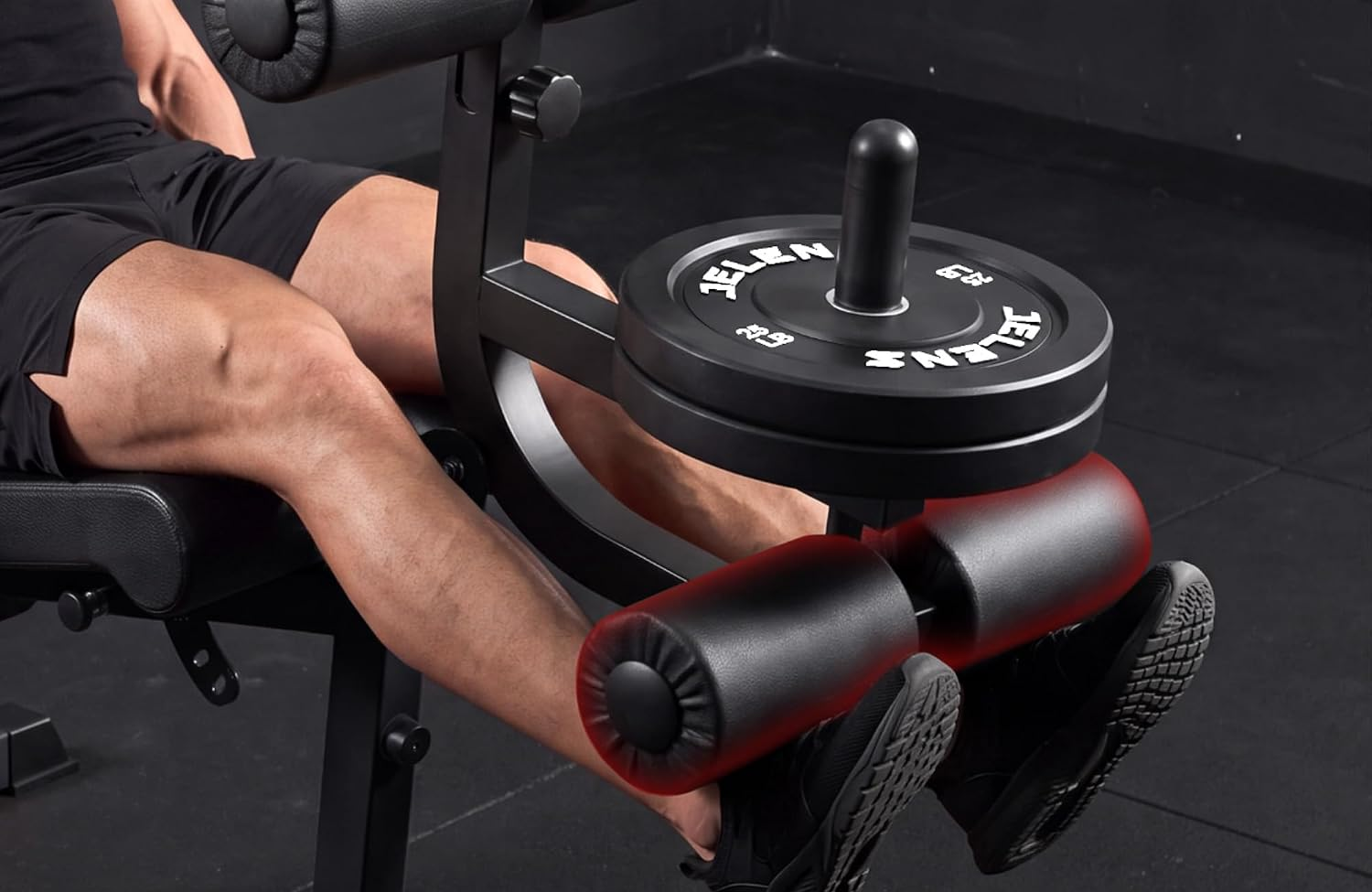
The biggest mistake here is measuring the machine and calling it a day. The listed footprint tells you how much floor the frame occupies, but you still need room to sit down, adjust the pads, load your plates, and move your legs through the exercise.
Measure the Actual Workout Space
Before buying, mark the machine’s dimensions on your floor with tape. Then leave extra room around it for getting in and out and for the moving leg arm. A machine that technically fits against a wall may be pretty annoying to use once you’re sitting on it.
Think About Plate Storage
All five machines here are plate-loaded, so don’t forget the weights themselves. If your plates are already taking up half the room, a machine with built-in storage can be much easier to live with.
Look at 2-in-1 Machines
For a small gym, I really like the extension-and-curl combination. You’re getting quad and hamstring work from one frame instead of finding room for two machines. That’s one of the easiest ways to make a compact leg extension machine more useful.
Check the Adjustments
This matters more than it might seem. Your knee should line up properly with the machine’s pivot, while the seat, backrest, and leg roller need to suit your leg length. If several people will use the machine, having more adjustment positions can be a big advantage.
Don’t Automatically Buy the Smallest Machine
I’d resist that temptation. A smaller frame is great, but not if you end up cramped every time you use it. Think about the working footprint, not just the footprint on the product page.
Consider How You’ll Move It
If your home gym doubles as another room, machine weight matters. A 90-pound machine is much easier to shift than a substantially heavier commercial-style unit. Also measure your doorway and delivery route before ordering. These machines can arrive in surprisingly large boxes!
5 Mistakes to Avoid When Buying a Leg Extension Machine for a Small Home Gym
A machine can look compact on paper and still be a pain to use. These are the mistakes I’d avoid before ordering one.
- Only Measuring the Machine
Don’t measure just the listed length and width. Leave room to get on and off, adjust the pads, and move the leg arm through its full range.
- Forgetting About Your Weight Plates
All five machines are plate-loaded. If your plates are already stored somewhere else, make sure you have room for them too. Built-in storage can be a real advantage in a cramped gym.
- Buying the Smallest Machine Automatically
Small doesn’t always mean better. You still need the seat, backrest, and leg roller to fit your body properly. A slightly larger machine may be much more comfortable to use.
- Ignoring the Workout Footprint
This is probably the easiest one to miss. The machine might fit neatly against a wall when it’s not being used, but the leg lever still needs space to move. Measure the area around the machine, not just underneath it.
- Overlooking How You’ll Move It
If your gym shares space with another room, think about whether you’ll need to move the machine regularly. A 95-pound machine is a very different proposition from a much heavier commercial-style unit.
- Choosing a Single-Purpose Machine
If space is really tight, I’d look for an extension-and-curl machine. Getting both movements from one frame can save you from finding room for a second piece of equipment.
FAQs
What is the best leg extension machine for a small home gym?
Look for a machine with a compact footprint, enough adjustment to fit your body, and preferably both leg extension and curl functions. A smaller machine isn’t automatically better if it’s uncomfortable or awkward to use.
How much space do you need for a leg extension machine?
Start with the machine’s listed footprint, then add room around it for getting on and off, adjusting the pads, loading plates, and moving the leg arm. The actual workout area will always be larger than the machine itself.
Are leg extension machines good for small home gyms?
They can be, especially if you choose a 2-in-1 model. An extension-and-curl machine gives you more lower-body training options without needing two separate machines.
What should I look for in a compact leg extension machine?
I’d pay attention to the footprint, adjustment range, machine weight, plate storage, and the amount of clearance needed during use. Also check whether the machine fits your height and leg length.
Is a leg extension machine for small spaces worth it?
If you specifically want machine-based quad and hamstring isolation, it can be. If you’re extremely short on room, though, a bench, resistance bands, or a cable system may take up less permanent floor space.
Are plate-loaded leg extension machines better for small gyms?
They can be easier to fit into a home gym because you don’t need a large weight stack attached to the machine. The trade-off is that you need somewhere to store your plates.
Which One’s the Best?
After spending time comparing these machines, one thing became pretty clear: the smallest footprint isn’t always the easiest machine to live with.
We found ourselves paying just as much attention to getting on and off, adjusting the pads, loading plates, and moving around the machine as we did to the dimensions on the spec sheet.
The GMWD LE02 is the one I’d reach for if space were my biggest concern. The MERACH felt more flexible when we played around with the adjustments, while the Z ZHICHI makes the most sense when you’re really trying to keep the footprint down.
Before buying, I’d still tape the dimensions out on your floor. That’s what I’d do at home. It gives you a much better idea of whether you can actually train comfortably once the machine is in place.