If you’re setting up a gym in a basement or room with a low ceiling, a power tower can be surprisingly tricky to fit.
I’ve found that the listed height alone doesn’t tell the whole story. You also need enough room above your head to actually do pull-ups comfortably.
That’s why I focused on adjustable models when putting together this guide to the best power tower for low ceiling spaces.
I’ll compare a few options, including a short power tower and compact designs, so you can find one that fits your ceiling without making your workouts awkward.
Best Power Tower For Low Ceiling: Comparison Table
Before getting into the individual picks, I’d look at the height range first. With a low ceiling, that matters more than having a long list of extra features.
I’ve also included the footprint and weight capacity because you still want the tower to feel stable once you start doing pull-ups and dips.
| Power Tower | Best For | Height Range | Weight Capacity | Low-Ceiling Advantage |
| SPORTSROYALS Free Standing Power Tower | Best overall | 57.09–83.07″ | 360 lbs | Very low minimum height and 8 adjustment levels |
| Trlakepreble Power Tower | Low ceilings + small rooms | 65–82.7″ | 330 lbs | Specifically designed around low-ceiling, space-saving use |
| DERACY Free Standing Power Tower | Lowest overall height | 62.25–78″ | 330 lbs | 78″ maximum height gives you more overhead room |
| SogesPower Power Tower | Budget option | 65–82.7″ | 330 lbs | Adjustable down to 65″ |
| RELIFE REBUILD YOUR LIFE Power Tower | More height flexibility | Up to 86″* | Up to 400 lbs* | Compact footprint with adjustable height |
*RELIFE sells multiple versions, so check the exact model’s current specifications before buying.
For a really tight ceiling, I’d pay particular attention to the minimum height, not just the advertised overall height. A tower that can drop several inches may make the difference between being usable and having to return it.
1. SPORTSROYALS Pull Up Bar Power Tower – Best Overall
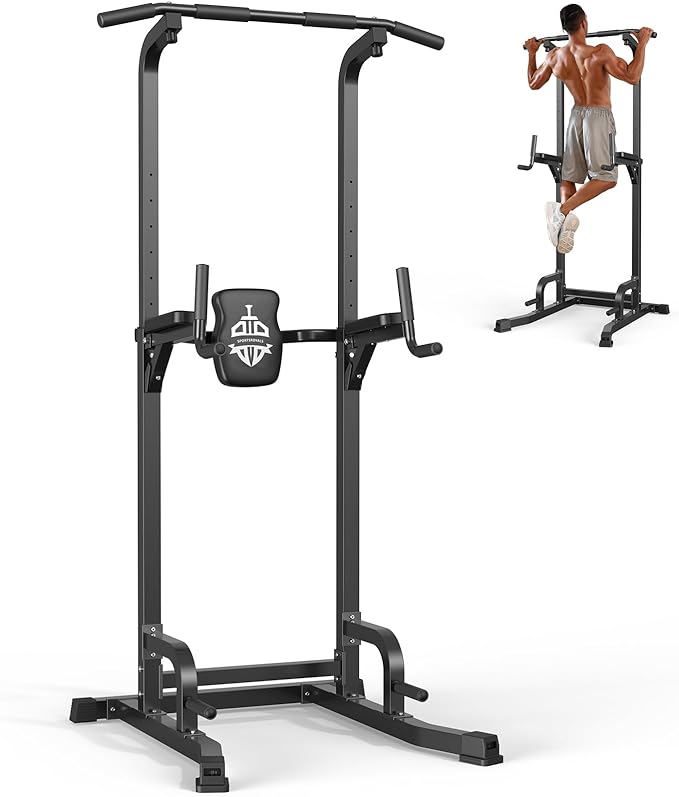
This is a good fit if you want a versatile power tower that can be lowered quite a bit when ceiling height is your main limitation.
- Height adjustment: 57.09–83.07 inches
- Height settings: 8
- Weight capacity: 360 lbs
- Backrest: 5 adjustment levels
- Exercises: Pull-ups, dips, leg raises, push-ups and more
- Base: Wide Π-shaped design with adjustable foot covers
The big reason I included the SPORTSROYALS here is its 57.09-inch minimum height. That’s much lower than many fixed-height power towers, giving you considerably more flexibility if you’re working with a basement or other room where ceiling height is tight.
You can raise it when you need more room for a taller user, then bring it down when ceiling clearance becomes the priority. Just remember that lowering the bar doesn’t eliminate the need for overhead space during pull-ups. Your own height and how you perform the movement still matter.
What We Like
- Very low minimum height
- Wide adjustment range
- 360-lb claimed capacity
- Supports several bodyweight exercises
What Could Be Better
- The 83.07-inch maximum height can still be too tall for some low-ceiling rooms.
- The supplied listing has an unclear footprint specification, so I’d verify the current dimensions before buying.
If I were trying to fit a power tower into a genuinely awkward room, the large height adjustment range is what would catch my attention here. It’s especially useful if more than one person will use the tower and you need to change the height between workouts.
Read: Best Elliptical For Low Ceiling Basement
2. Trlakepreble Power Tower – Best for Low Ceilings and Small Spaces
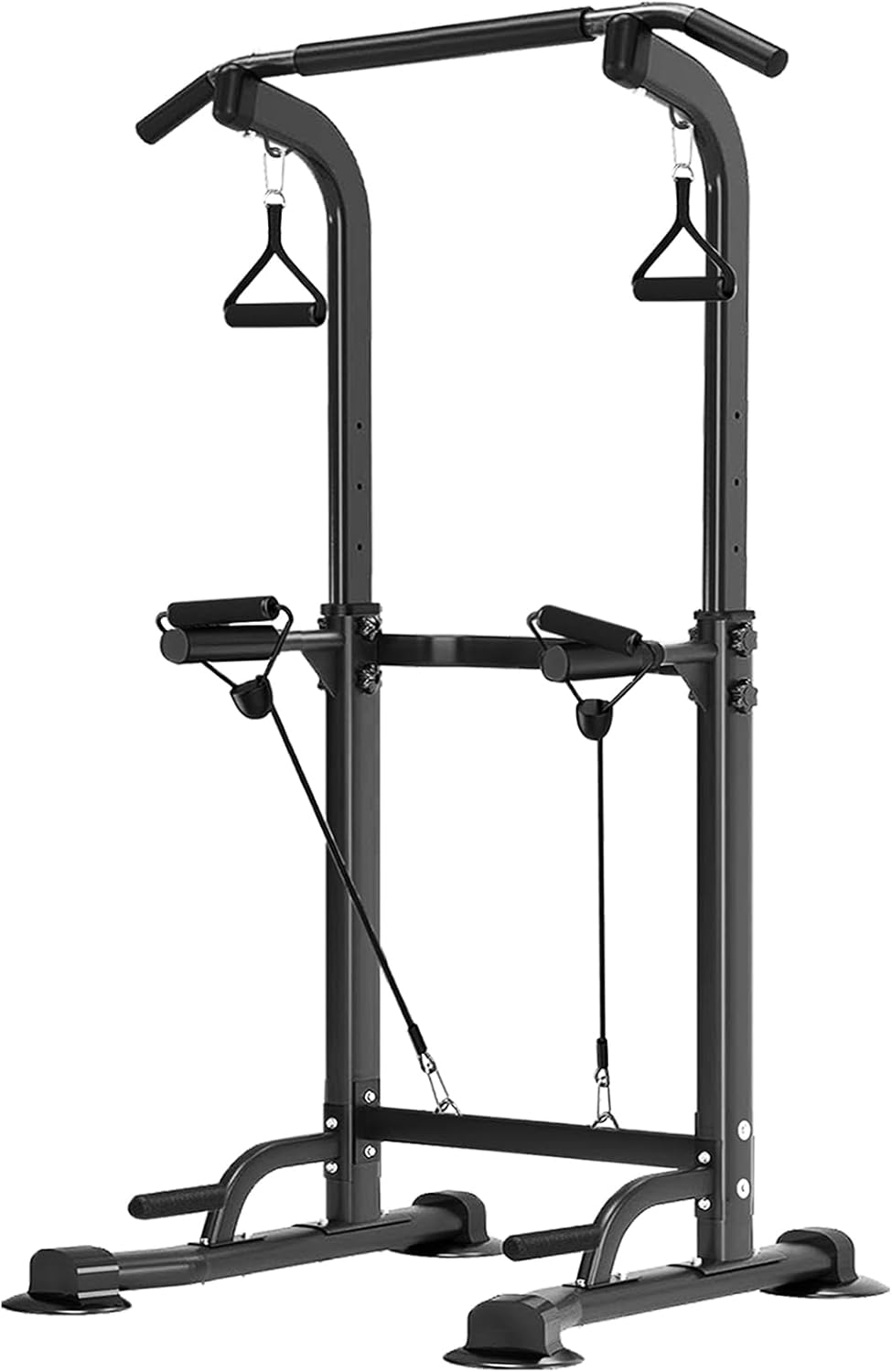
This one makes sense if you’re dealing with both a low ceiling and limited floor space, especially in a basement, bedroom, or small home gym.
- Height adjustment: 65–82.7 inches
- Height settings: 10
- Footprint: 6.6 sq. ft.
- Weight capacity: 330 lbs
- Base: Non-slip suction cups
- Resistance-band hooks: Included
What I like about the Trlakepreble is that its design seems to have the low-ceiling problem in mind from the start. At 65 inches on its lowest setting, you have considerably more room to work with than you would with a tall, fixed power tower.
The 10 height settings also give you some flexibility to find a position that works with both your ceiling and your height.
The trade-off is that taller users may not get as comfortable a pull-up position. The listing itself notes that users over 6 feet may have reduced comfort at the 83-inch maximum height.
What We Like
- Low 65-inch starting height
- Small 6.6 sq. ft. footprint
- 10 height adjustments
- Resistance-band hooks add some extra training options
What Could Be Better
- Taller users may find the pull-up position restrictive.
- 330-lb capacity is lower than the SPORTSROYALS.
- You’ll still need to measure your actual ceiling clearance before buying.
I’d look at this one if your home gym is squeezed into a small basement or spare room. It doesn’t try to be a huge multi-station machine, and the relatively low height makes it a practical compact power tower for tighter spaces.
Checkout: Best Home Gym Setup Under $300
3. DERACY Free Standing Power Tower – Best for the Lowest Maximum Height

This is the one I’d look at first if your biggest concern is simply keeping the power tower as low as possible.
- Height adjustment: 62.25–78 inches
- Height settings: 10
- Weight capacity: 330 lbs
- Base: Reinforced H-shaped design
- Pull-up and dip handles: Padded
- Resistance bands: 2 included
The 78-inch maximum height is what makes the DERACY stand out. Instead of buying a tower that can extend well beyond your ceiling, this one keeps the entire adjustment range relatively low.
That can be especially useful in a basement with a ceiling around 7 feet. You still need to consider your own height and the clearance needed while doing pull-ups, but having a lower starting and maximum height gives you more room to work with.
I also like that it has 10 height positions. You aren’t stuck with one awkward setting just because your ceiling is low.
What We Like
- 78-inch maximum height
- 10 height adjustments
- 330-lb claimed capacity
- Includes two assistance bands
What Could Be Better
- Taller users may have to bend their knees during pull-ups.
- The shorter height can limit overhead range of motion.
- The exact footprint should be checked on the current listing before purchase.
If ceiling height is the problem you’re trying to solve first, the DERACY makes a lot of sense. It’s a particularly interesting short power tower for a basement or other room where a taller tower simply isn’t practical.
4. SogesPower Power Tower – Best Budget Option

This is a good option if you want an adjustable tower for a low-ceiling room without taking up a huge amount of floor space.
- Height adjustment: 65–82.7 inches
- Height settings: 10
- Footprint: 38.6 × 32.3 inches
- Weight capacity: 330 lbs
- Base: H-shaped design
- Bottom: Large suction cups
The 65-inch minimum height is the main reason I’d consider the SogesPower for a low-ceiling setup. You can bring the pull-up bar down considerably instead of having to work around a fixed-height station.
The footprint is also worth paying attention to. At roughly 38.6 × 32.3 inches, it doesn’t need an enormous amount of floor space, which is useful if your basement gym is already crowded with a bench, dumbbells, or other equipment.
One thing I wouldn’t overlook is the floor surface. The manufacturer recommends using the tower on a flat concrete floor rather than carpet, so that’s worth checking before you commit to it.
What We Like
- 65-inch minimum height
- 10 height adjustment positions
- Reasonable footprint
- 330-lb claimed capacity
What Could Be Better
- 82.7-inch maximum height may still be too tall for some ceilings.
- Suction cups work best on the recommended hard, flat surface.
- Taller users may need to compromise on pull-up clearance.
I’d consider this a practical budget choice if you’re building a power tower for basement use and have a reasonably flat, hard floor. Just measure the ceiling and floor area first rather than assuming the adjustable height will solve everything.
Don’t Miss: Best Leg Press Machine for Small Home Gym
5. RELIFE REBUILD YOUR LIFE Power Tower – Best for More Height Flexibility

This one is better suited to someone who has a somewhat low ceiling but still wants a compact tower with enough adjustment for different users.
- Listed dimensions: 34 × 26.4 × 86 inches
- Weight capacity: Up to 400 lbs on the supplied model
- Height adjustment: 9 positions
- Armrest adjustment: 3 levels
- Backrest adjustment: 4 levels
- Material: Alloy steel
The RELIFE is a slightly different case from the other towers here. Its compact 34 × 26.4-inch footprint is useful when floor space is limited, but the listed 86-inch height means I wouldn’t put it at the top of the list for a truly low basement ceiling.
What makes it worth considering is the adjustable design. You can lower the pull-up bar for shorter users rather than always keeping it at its highest setting. That gives you some flexibility if the tower will be shared.
Just be careful when shopping because RELIFE sells multiple versions of its power tower, and the published height and weight specifications can differ between models.
What We Like
- Compact floor footprint
- 9 height adjustments
- Adjustable armrests and backrest
- High claimed weight capacity on the supplied model
What Could Be Better
- The listed 86-inch height can be too tall for many low-ceiling rooms.
- Different RELIFE models have different specifications.
- Not the first one I’d choose for a very low basement ceiling.
I’d consider this one if your ceiling is only moderately low and you also care about keeping the footprint compact. If every inch of overhead clearance matters, though, I’d stick with one of the shorter towers above.
How to Choose a Power Tower for a Low Ceiling
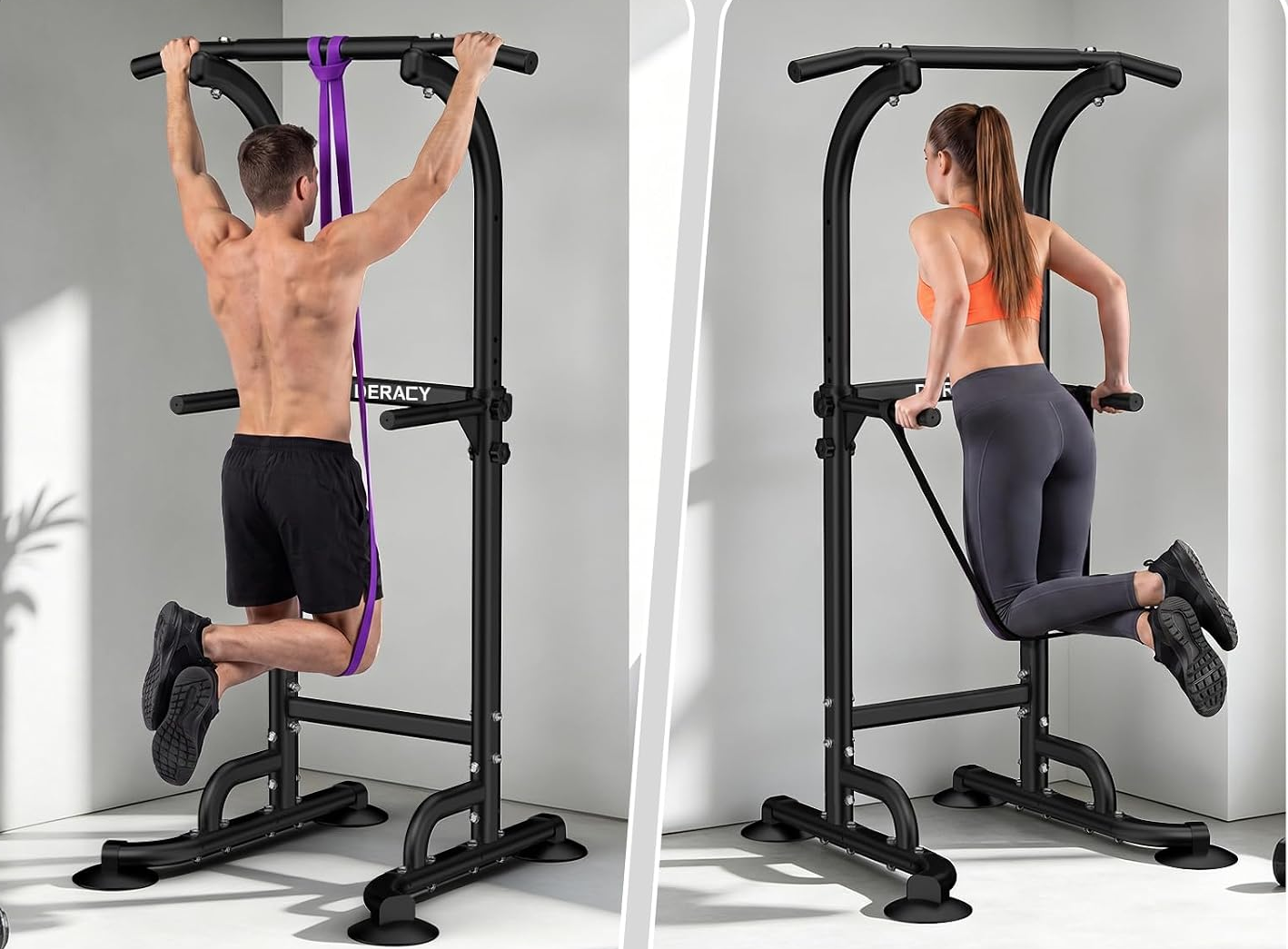
If you’re shopping for a low ceiling power tower, I’d start with a tape measure rather than the product features. A few inches can make a surprisingly big difference here.
Measure the Actual Ceiling Height
Measure from the floor where the tower will sit to the lowest point above it. In a basement, that might be a beam, pipe, duct, or light fixture rather than the main ceiling.
Look at the Minimum and Maximum Height
Don’t just look at the tower’s advertised height. Check how low the pull-up bar can actually be set.
For example, the DERACY drops to 62.25 inches, while the SPORTSROYALS can go down to 57.09 inches. That adjustment range is much more useful in a low room than a tower with only one fixed height.
Think About Your Own Height
This is where things get a little tricky. Lowering the bar helps with the ceiling, but a taller person may have to bend their knees during pull-ups.
That’s not necessarily a dealbreaker, but I’d rather know that before buying than discover it after assembling a 100-pound piece of equipment.
Leave Room for Pull-Ups
The tower fitting underneath your ceiling doesn’t automatically mean you have enough room to use it comfortably.
Think about where your head will be at the top of a pull-up and whether there are beams, pipes, or lights directly above you. If pull-ups are the main reason you’re buying the tower, this matters more than the tower’s overall feature list.
Check the Basement Floor
If you’re putting the tower on a basement floor, pay attention to the base design too. Suction cups can work well on a flat, hard surface, but they’re not something I’d blindly assume will work the same way on carpet or an uneven floor.
Measure Before You Order
I’d measure three things: ceiling height, available floor space, and your own usable pull-up clearance. Then compare those numbers with the tower’s actual dimensions and adjustment range.
That simple check can save you from buying a tower that technically fits the room but isn’t comfortable to use.
5 Mistakes to Avoid
A low ceiling makes power tower shopping a little less forgiving. These are the mistakes I’d avoid before placing an order.
- Only Checking the Tower’s Maximum Height
A tower that reaches 83 or 86 inches isn’t automatically unusable. If it adjusts much lower, it may still work. Check the minimum height and adjustment range too.
- Assuming an Exact Height Match Is Enough
If your ceiling is 84 inches, don’t buy an 84-inch tower and assume you’re fine. You still need room for your head and movement during pull-ups.
- Forgetting Beams, Pipes, and Lights
Basements rarely have perfectly clear ceilings. Measure from the floor to the lowest obstruction directly above where the tower will sit.
- Ignoring Your Own Height
A very short tower solves the ceiling problem but may force a tall user to bend their knees more than expected. Consider how comfortable the pull-up position will actually be.
- Measuring Only the Tower
Don’t stop at height. Check the footprint, too. A tower might fit under your ceiling perfectly but leave too little room around it for dips, leg raises, or simply moving around your home gym.
FAQs
What height should a power tower be for a low ceiling?
There isn’t one ideal height for everyone. Look for a tower with a low minimum height and enough adjustment range to give you comfortable pull-up clearance in your specific room.
Can I use a power tower in a basement?
Yes, as long as the tower and your workout position fit comfortably under the ceiling. For a power tower for basement use, also check the floor surface and the stability of the base.
What is a short power tower?
A short power tower is simply a tower with a lower overall height or a pull-up bar that can be adjusted much lower than typical models. This makes it easier to use in rooms with restricted ceiling height.
Is a 7-foot ceiling high enough for a power tower?
It depends on the tower and your height. A model that adjusts well below 7 feet may work, but you still need enough space above your head when doing pull-ups.
Can tall people use a low power tower?
They can, but there may be a compromise. You might need to bend your knees during pull-ups, particularly with models that have a lower maximum height.
Should I choose the shortest power tower available?
Not necessarily. The shortest model may solve your ceiling problem but give you less comfortable pull-up clearance. I’d balance the tower’s height with your own height and the exercises you plan to do.
A Few More Words
If you’re dealing with a low ceiling, I’d put height adjustment ahead of most other power-tower features. The SPORTSROYALS stands out because it can drop as low as 57.09 inches, giving you plenty of flexibility when ceiling space is tight.
The DERACY is another interesting option if you want to keep the overall tower height down, while the Trlakepreble makes sense when floor space is limited too.
Before buying, though, I’d grab a tape measure and check the exact spot where you plan to put the tower. Measure the ceiling, look for beams or pipes, and think about your own head position during pull-ups.
Those few minutes of measuring can save you from ending up with equipment that technically fits but is frustrating to use.