You can build a really useful home gym with $1,000, but you have to be selective about what you buy.
A rack, barbell, plates, bench, and dumbbells can eat up your budget fast. So instead of trying to squeeze in every piece of equipment, this home gym setup under $1000 focuses on the basics that give you the most options.
You’ll have what you need for squats, presses, deadlifts, rows, pull-ups, and plenty of accessory work, without buying equipment you probably won’t use.
Best Home Gym Setup Under $1000 (Complete Guide)
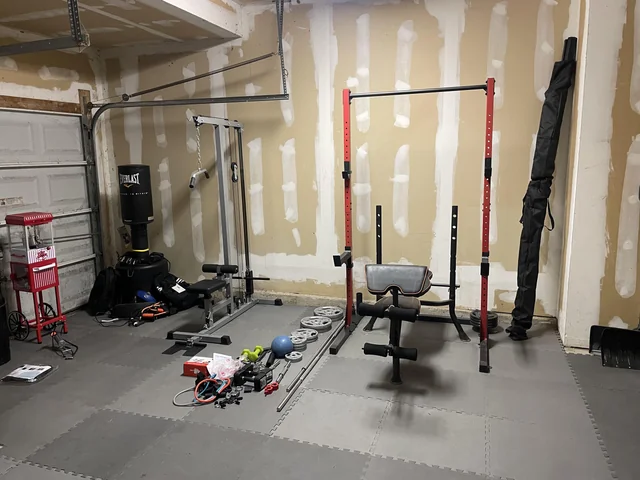
The easiest way to make a $1,000 budget work is to build around a rack, barbell, and plates first. Those three give you a solid base for heavier lifts.
From there, add a bench, adjustable dumbbells, and a few smaller pieces to cover the exercises the barbell setup doesn’t handle as well.
Here’s how I’d divide the budget:
Equipment
Recommended Product
Approx. Budget
Purpose
Power Rack
ULTRA FUEGO Power Cage
~$400
Squats, benching, barbell work
Barbell
CAP Barbell Olympic Bar
~$100
Squats, deadlifts, presses, rows
Weight plates
CAP Barbell Olympic Plates
~$250
Progressive loading
Adjustable bench
FLYBIRD Adjustable Bench
~$100
Flat/incline pressing and accessories
Adjustable dumbbells
Amazon Basics Adjustable Dumbbells
~$80
Accessory and unilateral work
Pull-up bar
Basic doorway/wall-mounted bar
~$30
Pull-ups and chin-ups
Resistance bands
Basic resistance band set
~$25
Warm-ups, assistance, accessories
Total
~$985
Prices will move around, especially on Amazon, so think of these numbers as a target rather than a promise. If one item is more expensive when you buy, the easiest place to make room is usually the smaller accessories, not the rack, barbell, or plates.
The exact products can also change as long as you keep the same idea: spend most of the budget on equipment that expands what you can actually train.
Why This Setup Makes Sense
The main idea is pretty simple: spend most of the $1,000 on equipment that gives you a lot of training options.
The rack, barbell, and plates are the foundation. Together, they let you work on squats, deadlifts, presses, rows, and other big lifts. The adjustable bench makes the barbell and dumbbells much more useful, while the pull-up bar covers an important movement that the weights don’t.
The dumbbells and bands are there to fill in the gaps. You can use them for unilateral work, smaller muscle groups, warm-ups, and exercises that are easier to do with lighter weights.
This also keeps the setup relatively compact. If you’re not sure whether everything will fit, use our Home Gym Space Calculator to check your available floor space and ceiling height before buying equipment.
You don’t need a room full of machines to train your whole body. And as your budget grows, you can add more plates, upgrade the bench, or add cable equipment without replacing the basic setup.
Power Rack
Recommended: ULTRA FUEGO UF-896 Power Cage

If you’re trying to build a home gym under $1000, I’d make the power rack the centerpiece of the setup. The ULTRA FUEGO UF-896 gives you a lot more than just a place to rack your barbell.
The cage uses 50 × 50 mm steel uprights with 1.5 mm thick steel, adjustable J-hooks and safety bars, and a listed 1,002-pound capacity. It also comes with dip handles, a landmine attachment, pulley system, lat pulldown bar, cable handles, band pegs, and weight-plate storage pegs.
That means one piece of equipment covers a lot of the exercises you’d normally need several pieces of equipment for. You can use it for:
- Barbell squats
- Bench presses
- Overhead presses
- Pull-ups
- Dips
- Lat pulldowns
- Cable rows
- Triceps pushdowns
- Face pulls
- Landmine presses and rows
- Band exercises
The listed footprint is about 63 × 47 inches, with a height of 82.8 inches. That makes the ceiling height worth checking before you buy, especially if you’re putting the rack in a basement or garage.
Before ordering, use our Power Rack Fit & Ceiling Clearance Calculator to check whether the rack will fit your room and leave enough usable clearance.
The other nice thing is that the rack leaves room to grow. You can start with a barbell and plates, then make more use of the pulley and landmine attachments as your training develops.
For this $1000 home gym setup, I’d rather put the money into a rack like this that covers several training needs than buy a basic squat stand and then have to purchase separate cable and dip equipment later.
Budget target: Use the current price as the reference point, but aim to keep the rack around 300–400 of the overall budget. That gives us enough room for the barbell, plates, bench, dumbbells, and bands without pushing the total too far over $1,000.
Barbell
Recommended: CAP Barbell Olympic Barbell

Once you have the rack, the next thing you need is a barbell that can handle the main lifts. You don’t need anything fancy for a home gym under $1000. A standard 7-foot Olympic bar with a 2-inch sleeve is enough for squats, deadlifts, presses, and rows.
The CAP Barbell Olympic Bar is a straightforward choice for this setup. It’s designed around the standard Olympic plate size, so you can build your plate collection over time without having to replace the bar later.
You’ll use the barbell for most of the big movements in the gym:
- Back squats
- Deadlifts
- Bench press
- Overhead press
- Barbell rows
- Romanian deadlifts
- Front squats
I’d put more of the budget into the plates than into buying an expensive specialty bar. At this stage, having enough weight to actually progress matters more than having a competition-style bar with features you probably won’t need.
The bar also works well with the ULTRA FUEGO rack, giving you a simple setup for the main compound lifts while the rack’s pulley and landmine attachments handle some of the accessory work.
Budget target: Around 100–130.
One thing to check before ordering is the bar’s length, sleeve diameter, weight rating, and compatibility with the plates you choose. Sticking with standard Olympic sizing keeps the rest of the setup much simpler.
Weight Plates
Recommended: CAP Barbell Olympic 2-Inch Weight Plates

There’s not much point in buying a good barbell and rack if you don’t have enough weight to use them. For this home gym setup under $1000, I’d put a decent portion of the remaining budget toward a basic set of Olympic plates and add more later as your strength increases.
CAP Barbell’s 2-inch Olympic plates are a straightforward option for this type of setup. They fit a standard Olympic bar and are available in different weights, so you can build a set around your current strength instead of buying a huge amount of weight you won’t use yet.
A starter setup could include a mix of:
- 45-lb plates
- 25-lb plates
- 10-lb plates
- 5-lb plates
- 2.5-lb plates
The smaller plates are worth having. They let you make smaller jumps when you’re trying to add weight to presses, rows, and other lifts where another 10 or 20 pounds might be too much.
If you’re trying to build a home gym for $1000, don’t feel like you need 300 or 400 pounds of plates on day one. Buy enough to train safely and progress, then add heavier plates later.
Budget target: Around 250–300 for the initial plate set.
One thing I’d avoid is spending the entire remaining budget on plates just because the rack can technically hold them. The goal is to have enough weight for your current training while still leaving room for the bench, dumbbells, and other equipment that make the gym more versatile.
Adjustable Bench
Recommended: FLYBIRD Adjustable Weight Bench
A bench doesn’t need to be complicated, but it does need to be sturdy enough that you feel comfortable using it with the barbell and dumbbells. For this home gym under $1000, an adjustable bench gives you more options than a basic flat bench without taking up much more space.
The FLYBIRD Adjustable Weight Bench is a practical budget option because you can change the backrest position for flat and incline exercises. That gives you more than just a place to sit while pressing. You can use it for:
- Flat dumbbell bench press
- Incline dumbbell press
- Seated shoulder press
- Chest-supported dumbbell rows
- Bulgarian split squats
- Dumbbell curls
- Triceps extensions
- Core exercises
It also becomes part of the barbell setup when you place it inside the power cage for bench pressing.
Pay attention to the bench’s weight capacity, dimensions, adjustment positions, and stability rather than just its price. You want something that stays planted when you’re pressing or doing single-leg exercises.
For a $1000 home gym setup, I’d aim to spend roughly 100–150 here. There’s no need to spend several hundred dollars on a premium commercial bench at this stage, but I also wouldn’t choose the absolute cheapest bench just to save $20 or $30.
If you’re short on space, look for a bench that can be moved or stored vertically when you’re finished training. That can make a surprisingly big difference in a garage or spare bedroom.
Adjustable Dumbbells
Recommended: Amazon Basics Adjustable Dumbbells

The barbell will handle your heavier compound lifts, but dumbbells are still worth having in a $1000 home gym setup. They make unilateral exercises easier, give you more freedom of movement, and are handy when you don’t want to load up the barbell for a smaller exercise.
I’d go with adjustable dumbbells rather than buying a rack of fixed dumbbells. They take up much less space and let you put the money toward the equipment that matters more. You can use them for:
- Dumbbell bench presses
- Incline presses
- One-arm rows
- Shoulder presses
- Goblet squats
- Romanian deadlifts
- Lunges and split squats
- Curls
- Lateral raises
- Triceps extensions
They’re especially useful for working one side at a time. For example, a one-arm dumbbell row or split squat can be easier to set up than a barbell variation.
Budget target: Around 70–100.
At this budget, I wouldn’t chase a huge weight range. The barbell and plates are already there for heavy work. The dumbbells are mainly filling the gaps, so a reasonably sized adjustable pair is enough to start.
And if you eventually find yourself regularly maxing out the dumbbells, that’s a good problem to have. At that point, you can put your next 100–200 toward heavier adjustable dumbbells or additional plates, depending on how you train.
Resistance Bands
Recommended: Fit Simplify Resistance Loop Exercise Bands

Bands are one of those small purchases that can quietly make a home gym more useful. They don’t take up much room, cost very little compared with most gym equipment, and work well alongside the rack, barbell, and dumbbells.
For this home gym setup under $1000, I’d use a set of resistance bands mainly for warm-ups, assistance, and lighter accessory work. You can use them for:
- Band pull-aparts
- Face pulls
- Shoulder warm-ups
- Assisted pull-ups
- Glute work
- Band rows
- Triceps exercises
- Lateral raises
- Adding resistance to push-ups
They’re also handy when you want to train without loading the barbell. You can keep a set next to the rack and grab them for a quick warm-up before squats or presses.
Budget target: Around 20–30.
You don’t need a huge collection of bands with dozens of resistance levels. A basic set with a few different resistances is enough for most people. Since the ULTRA FUEGO rack already includes band pegs, you can also make better use of bands than you could with a basic rack.
This is one area where I’d keep the spending low. The bands are there to complement the main equipment, not become the main part of your $1000 home gym.
What You Can Actually Train With This Setup
The nice thing about this setup is that you aren’t buying each piece for just one exercise. The rack, barbell, plates, bench, dumbbells, and pulley system all overlap in useful ways.
With everything in place, you can cover most of the basic movement patterns without needing another machine.
Training Focus
Exercises
Main Equipment
Squat
Back squats, split squats, goblet squats
Rack, barbell, dumbbells
Hinge
Deadlifts, Romanian deadlifts
Barbell, dumbbells
Horizontal push
Bench press, dumbbell press
Rack, bench, barbell, dumbbells
Vertical push
Overhead press, dumbbell shoulder press
Barbell, dumbbells
Horizontal pull
Barbell rows, cable rows, dumbbell rows
Barbell, pulley, dumbbells
Vertical pull
Pull-ups, chin-ups, lat pulldowns
Rack, pulley
Arms
Curls, triceps pushdowns, extensions
Dumbbells, pulley, bands
Core
Hanging knee raises, cable work, rollouts
Rack, pulley
Unilateral work
Lunges, split squats, one-arm rows
Dumbbells, barbell
That’s really the point of this home gym under $1000. You aren’t trying to own every type of gym equipment. You’re putting together a small number of pieces that work well together.
And because the ULTRA FUEGO rack includes the pulley system, dip handles, landmine, and pull-up setup, you get considerably more exercise options without having to keep adding separate machines.
If you’re training in a garage, this also keeps the equipment fairly centralized. Most of your workout can happen around the rack, with the bench and dumbbells moving in and out of the cage as needed.
What Not to Buy Yet
With a $1,000 budget, it’s easy to get carried away. There are plenty of machines and accessories that look useful, but you don’t need them right away.
Working with a much smaller budget? See our best home gym setup under $200 for a simpler way to get started.
- Skip the cardio machines
A treadmill, exercise bike, or rower can easily take a big chunk of the budget. If strength training is the main goal, I’d put that money into the rack, barbell, and plates first.
You can always add cardio equipment later.
- Don’t buy a separate cable machine
This is one of the easiest things to cross off the list. The ULTRA FUEGO UF-896 already includes a pulley system, along with a lat pulldown bar and cable handles.
Buying another cable machine would mostly duplicate equipment you already have.
- Skip a full dumbbell rack
Fixed dumbbells are convenient, but they take up a lot of space and can get expensive quickly. An adjustable pair makes more sense for a home gym under $1000.
You can always add heavier dumbbells later if you find that you need them.
- Don’t spend big on specialty machines
Leg extensions, pec decks, preacher curl machines, and similar equipment can wait. They’re useful additions once you have the basics covered, but they aren’t where I’d put limited money at this stage.
The rack, barbell, plates, bench, and dumbbells already give you plenty of ways to train those muscle groups.
- Don’t fill the gym with accessories
You don’t need five different ab machines, a collection of specialty handles, or an expensive storage system on day one.
Start with the equipment you’ll actually use. Once you’ve trained with the setup for a while, you’ll have a much better idea of what you’re missing.
That’s the main rule I’d follow when you build a home gym for $1000: buy equipment that adds a new training option, not another version of something you already own.
Alternative: Strength-Focused Setup
If your main goal is getting stronger on the big lifts, I’d make one small change to the setup: put more of the budget into the barbell and plates and less into the adjustable dumbbells.
The power rack already gives you plenty of options for accessory work, so you can start with a smaller adjustable dumbbell set and use the extra money for more plates.
That gives you more room to progress on:
- Squats
- Deadlifts
- Bench press
- Overhead press
- Barbell rows
You can still use the rack’s pulley system, landmine, dip handles, and pull-up bar for your accessory work.
This version makes the most sense if you’re building a garage gym under $1000 and expect barbell training to be the main focus.
If you prefer a mix of strength, general fitness, and dumbbell training, stick with the original setup.
Upgrade Path
You don’t need to buy everything at once. Start with the basics, train with them for a while, and then spend your next few hundred dollars on whatever you’re actually missing.
Another $100
I’d probably add more plates. If you already have enough weight, put it toward flooring, storage, or a small rack accessory.
Another $200
This is a good point to upgrade your dumbbells or add more plates. You could also improve the bench if that’s becoming the weak link.
Another $500
Now you can make a bigger upgrade, such as a larger plate collection, heavier dumbbells, a better bench, or additional rack attachments.
Don’t replace the equipment you already have just because something newer comes along. Build on your original setup and let your $1000 home gym grow as your training does.
FAQs
Is $1,000 enough to build a home gym?
Yes. You won’t have every machine you’d find in a commercial gym, but you can cover most strength-training basics with a rack, barbell, plates, bench, dumbbells, and a few accessories.
What should I buy first for a $1,000 home gym?
Start with the rack, barbell, plates, and bench. Those give you the foundation for your main lifts. Add dumbbells and smaller accessories after that.
Can I build a garage gym under $1,000?
Yes. A garage is actually a good fit for this type of setup, especially if you have enough ceiling height for the rack and enough room to move around it safely.
Do I need a separate cable machine?
Not with the ULTRA FUEGO rack used in this setup. It already includes a pulley system, lat pulldown bar, cable handles, and other attachments.
Should I buy more plates or heavier dumbbells first?
It depends on what you’re struggling with. If you’re running out of weight on your main barbell lifts, buy plates. If you mainly need more options for accessory work, heavier dumbbells may make more sense.
Can I build a home gym for $1000 without buying everything at once?
Absolutely. You can start with the rack, barbell, plates, and bench, then add dumbbells, bands, and other accessories as your budget allows.
Conclusion
If I were putting together a home gym with $1,000, I’d keep it simple.
I’d spend most of the money on the power cage, barbell, plates, and bench, because those are the pieces I’d expect to use in almost every workout.
Then I’d add adjustable dumbbells and bands to cover the exercises the barbell doesn’t handle as well.
I’d also resist the temptation to spend the whole budget just because it’s there. Start with the equipment you know you’ll use, train with it, and add to the gym when you actually find a gap.
That’s how I’d approach building a home gym setup under $1000 without wasting money on equipment that ends up collecting dust.